
The Cricket Matters System
Cricket performance and cricket injury are the same problem.
How your body produces, controls, and expresses force determines both.
The cricketer who can’t hit harder, the cricketer who can’t bowl faster, and the cricketer whose back keeps breaking down don’t have three different problems. They have one underlying problem showing up in three places. Most cricket development is organised around fixing each angle separately. The Cricket Matters System addresses them as one.
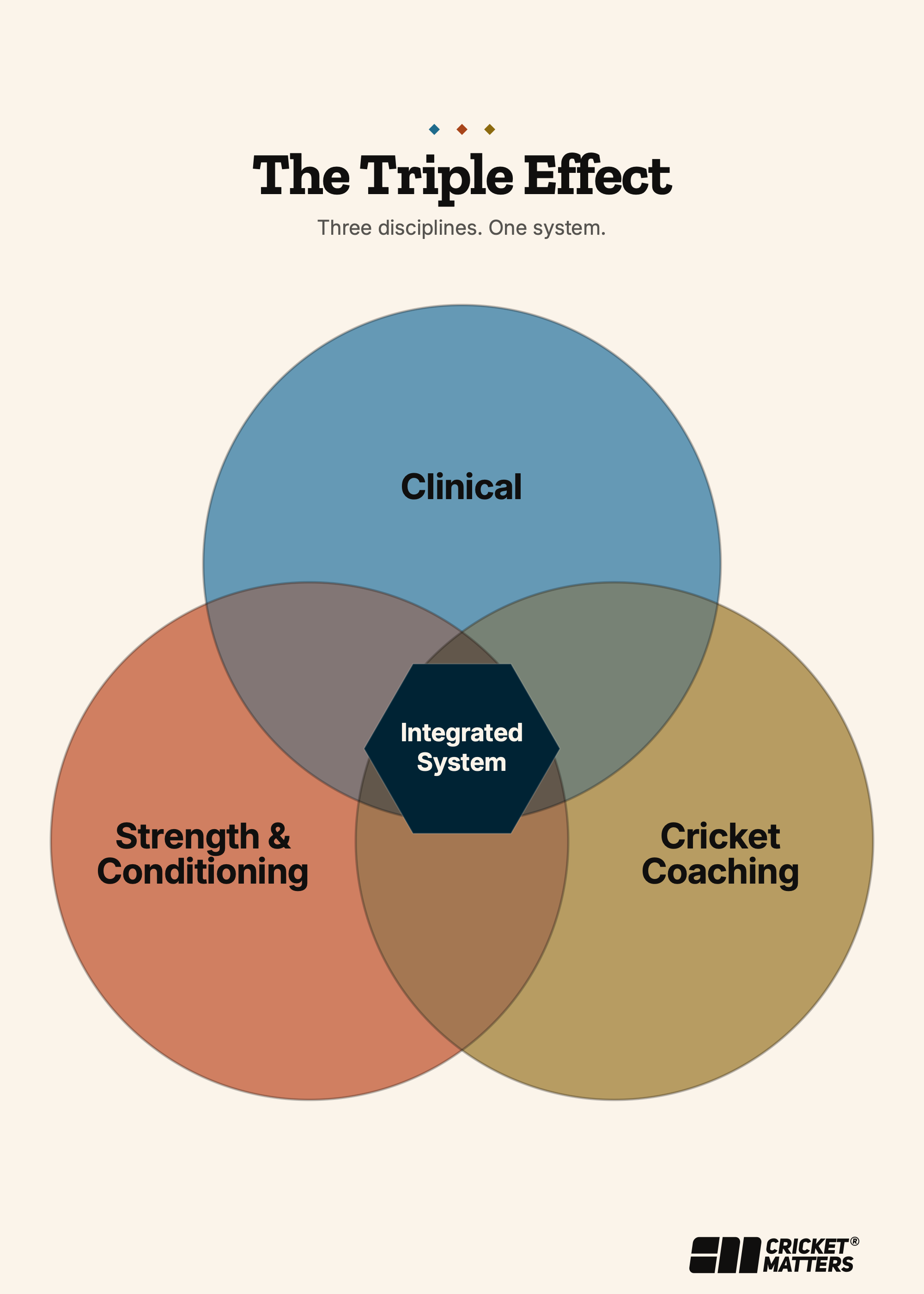
One practitioner. Three disciplines. One integrated system.
The Triple Effect — clinician, strength coach, cricket coach — held by the same person.
James Breese operates as a Sports & Clinical Therapist a Strength & Conditioning Specialist, and an ECB Cricket Coach. Three credentials. One person. Held in integrated practice, not run as three separate services.
Most cricket development happens in silos. Cricket coaching understands the action but not the body that produces it. Clinical pathways understand the body but not the cricket asking things of it. Strength and conditioning builds capacity without necessarily understanding either.
The Triple Effect is the source of authority behind the Cricket Matters System. The integrated framework is structurally honest because the same person holds all three domains. The reader does not have to hire three practitioners and hope they coordinate. The coordination is built into the practice.
Three pillars. Always run in this order.
Clinical Foundation. Performance Capacity. Technical Application.
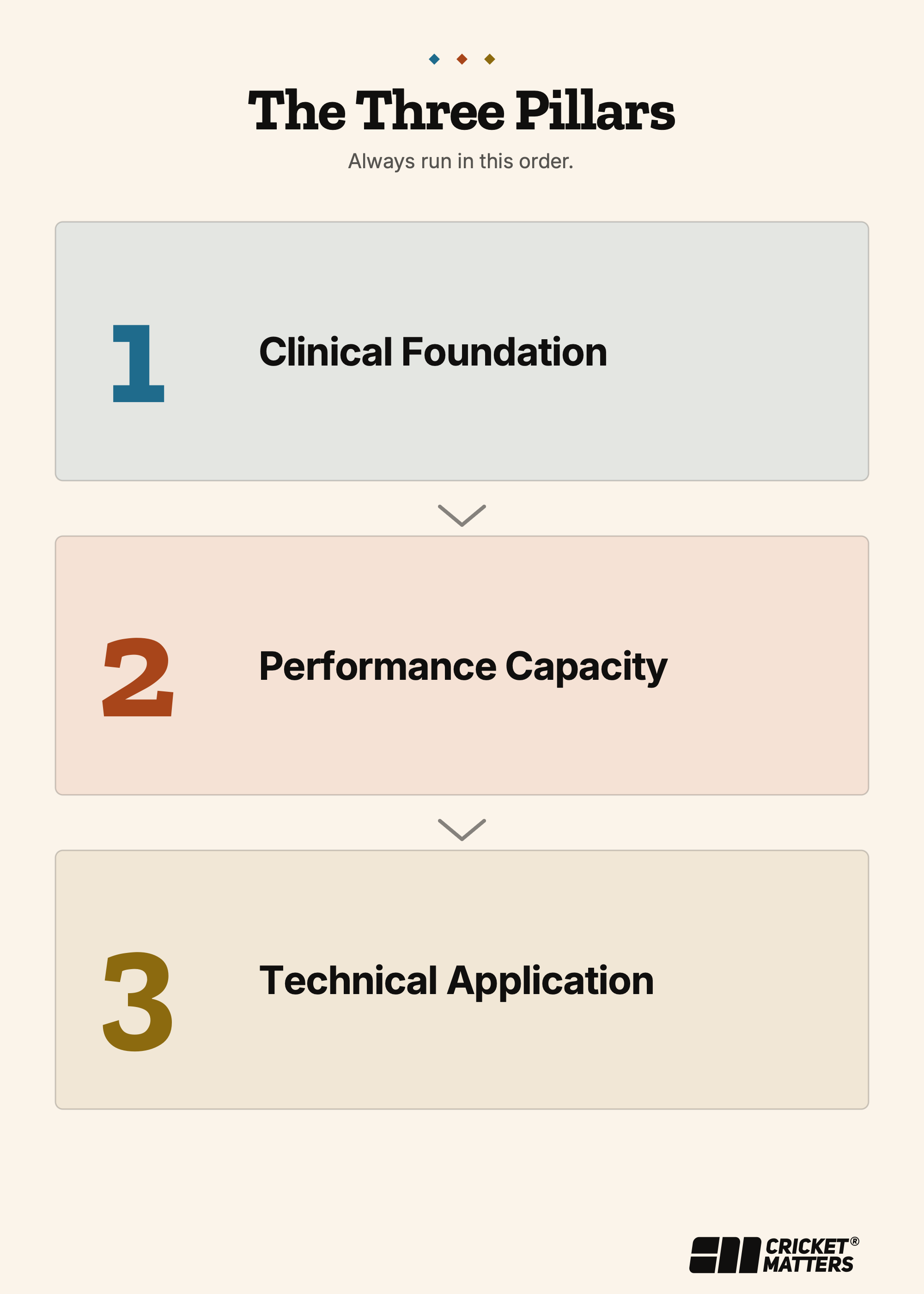
Clinical Foundation. Every athlete begins with assessment. The first job is to find the mechanical driver behind pain, breakdown, or stalled performance. Identify the constraint before any load is applied. The pillar of trust.
Performance Capacity. Once the foundation is stable, the system builds the physical capacity the body needs to tolerate cricket. Strength. Power. Speed. Workload tolerance. The biological substrate that holds the action together across a season.
Technical Application. Clinical findings and physical capacity applied to cricket-specific mechanics. The work that connects the body to the action — the bowling delivery, the batting shot, the throw — in a way that the underlying systems can support.
Foundation first. Capacity second. Technical work only once the body can support it. Skip the order and the system fails at the first load it cannot tolerate.
Five inputs. One output.
Health, Movement, Athleticism, Mindset, Nutrition — all feeding Technique.
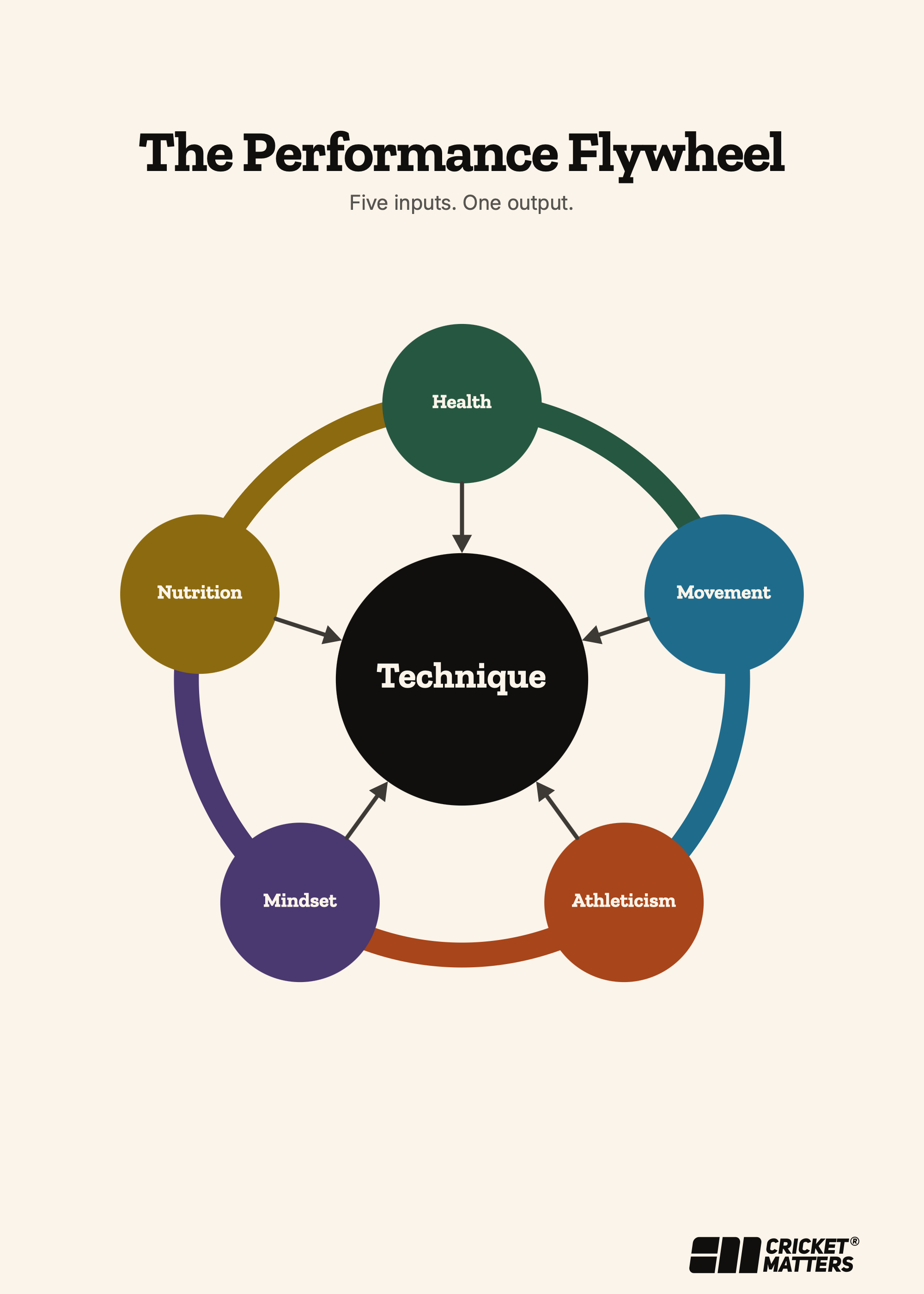
The Performance Flywheel is the model that governs cricket technical output. Five inputs turn each other in a ring, each feeding Technique at the centre. Technique is the visible performance output — the 90mph delivery, the huge 100m six, the bullet arm in the field. The five inputs are what produces it.
The five inputs are:
- Health. The substrate the body adapts on. Sleep, recovery, hormonal state, energy availability.
- Movement. How the cricketer moves when performing technique. Includes the assessment stack that diagnoses where movement breaks down: Clinical, Online, or In-Person.
- Athleticism. The engine. The body’s physical output: how much, how fast, how repeatable.
- Mindset. The mental layer. Decision quality, emotional control, performance under pressure.
- Nutrition. The fuel. Adaptation, recovery, and the substrate underneath training response.
When all five turn, Technique improves. When one stalls, output drops — sometimes visibly, sometimes through injury, sometimes through a plateau nobody can name.
Athleticism is built in a fixed order.
Movement Integrity. Physical Capacity. Force Expression. Mental Resilience runs through all three.
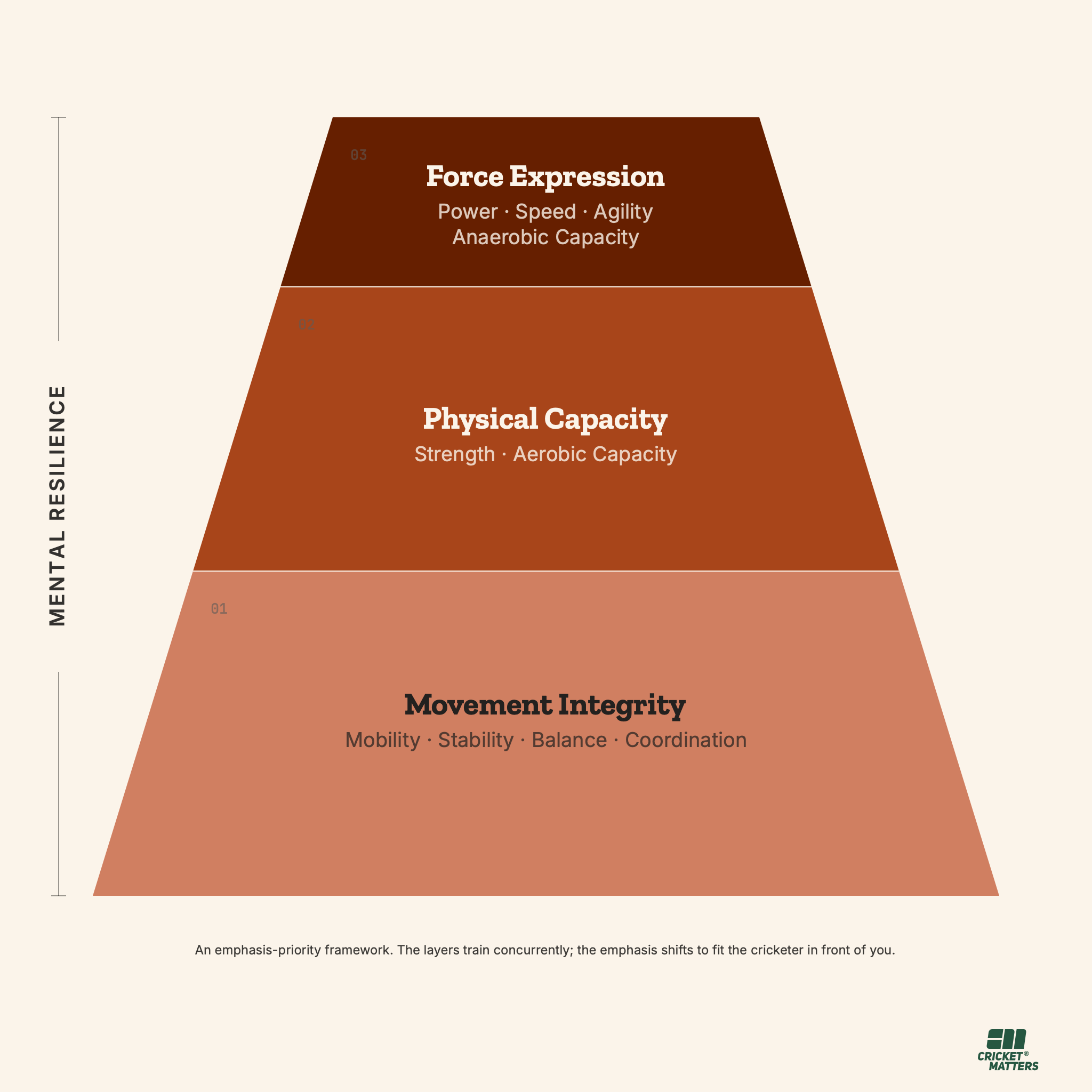
Inside the Athleticism node of the Flywheel sits the Cricket Performance Pyramid — the developmental order in which athleticism is actually built. You cannot skip floors.
Layer 1 is Movement Integrity (the body’s ability to move cleanly through the ranges cricket asks for — hip mobility, lumbopelvic control, joint range, balance). Layer 2 is Physical Capacity (the engine room — the strength and work tolerance the body needs to absorb training and sustain output across a season). Layer 3 is Force Expression (the output — power, speed, agility, anaerobic capacity, the qualities the eye sees at the ground).
Mental Resilience runs vertically through all three. The cross-pillar anchor that determines whether the athlete adapts or breaks under match-day load.
Most cricket development trains Layer 3 directly. Bowling drills. Batting power work. Sprint sessions. Without the Layer 1 and Layer 2 substrate underneath. The result: short-term gains followed by plateau, then breakdown.
When the system stalls, force leaks.
And it usually leaks into the lumbar spine.
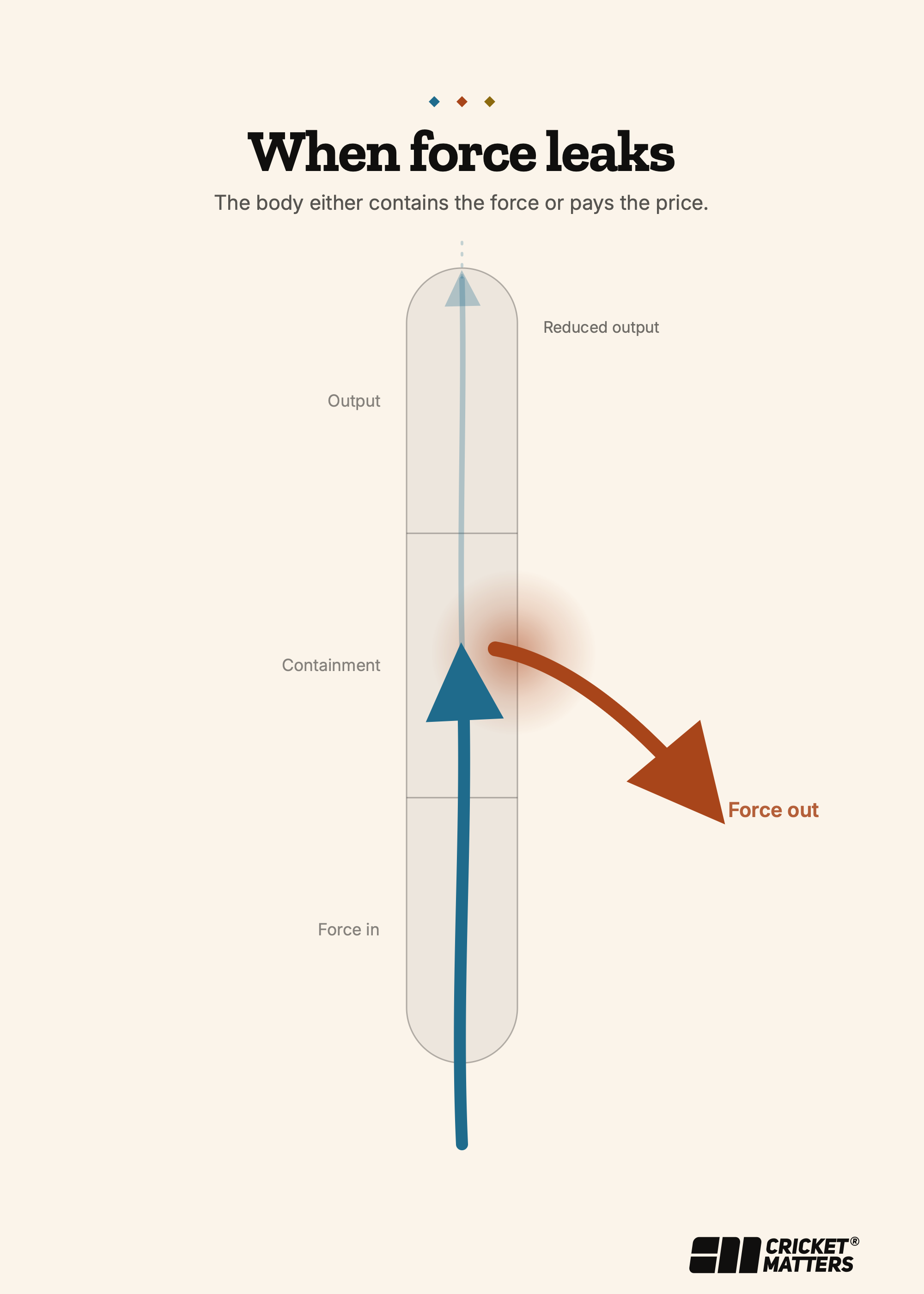
Cricketing actions generate centripetal force. The fast-bowler bowling. That batter playing the pull or sweep shot. The fielder throwing. The body has to contain that force and redirect it into the action.
When Movement Integrity or Physical Capacity is insufficient, the force does not disappear. It leaks — into the structures least able to handle it. Usually the lumbar spine. Sometimes the hip. Sometimes the shoulder or knee.
The leak shows up in two ways. As pain: back pain in a fast bowler, hip pain in batters, shoulder pain for fielders. As performance loss: force that should have gone into the ball arrives somewhere else first. They are the same phenomenon labelled differently.
This is why the Cricket Matters System addresses performance and injury as one problem. The physics underneath them is the same.
One system. Six doors.
Where you enter depends on what’s actually stopping you.
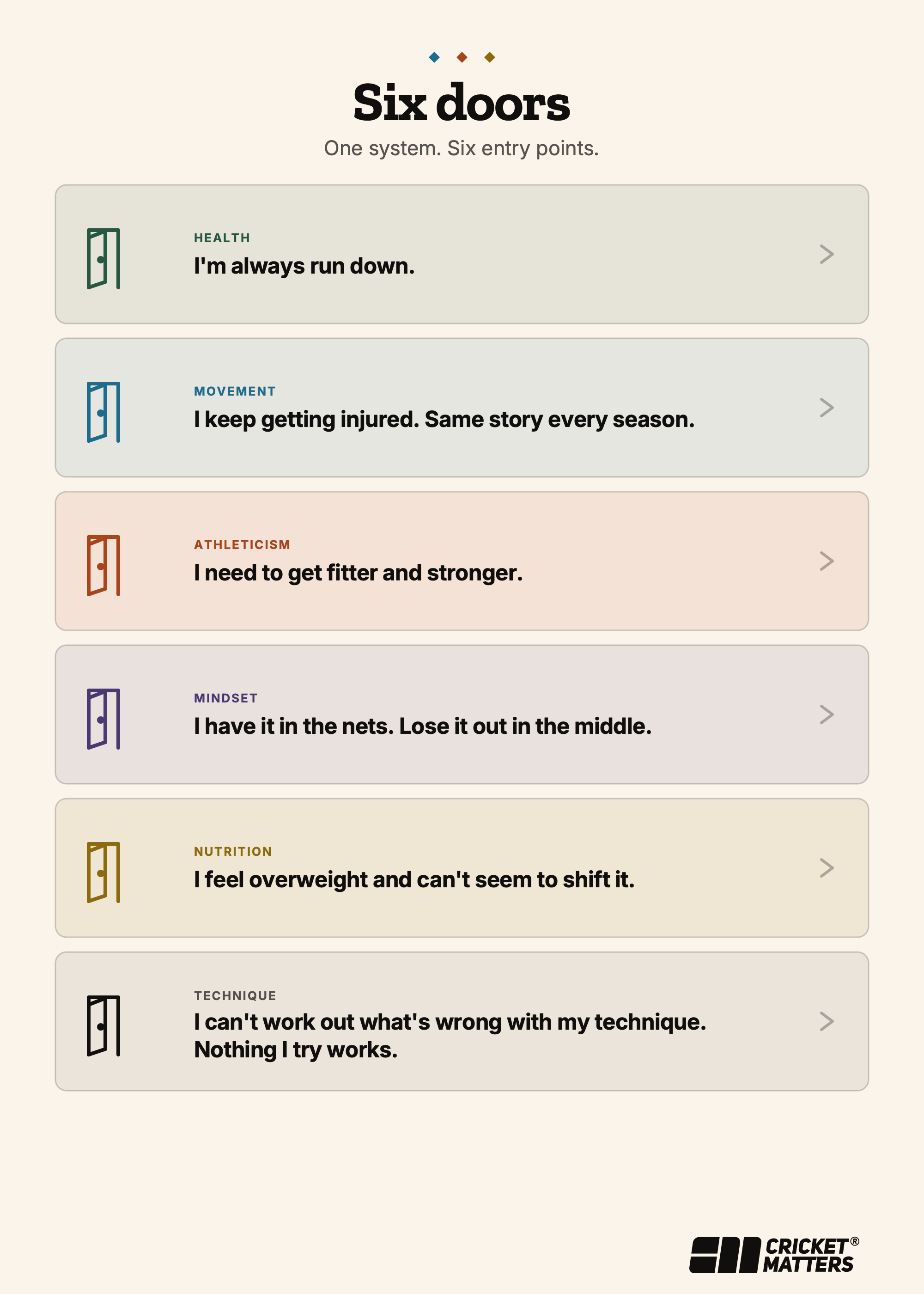
Most cricketers arrive at one of those six lines as the truest version of what’s actually stopping them. The line is what they feel. The door is where the system takes it from there.
Six lines, six doors, one system behind all of them. Each door opens onto the part of the system that works on the cause underneath what the cricketer just said — not the words themselves.
“I’m always run down” routes into Health — sleep, recovery, energy, how well the body bounces back between efforts. The system reads it as a sign the engine isn’t recovering, and goes after why.
“I keep getting injured. Same story every season.” routes into Movement. Pain that comes back the moment the load returns isn’t bad luck — it’s a mechanical constraint nobody’s named yet, and the door opens onto the assessment that names it.
“I need to get fitter and stronger” routes into Athleticism — the engine room. Strength, work tolerance, the capacity to take training and back it up week after week. The honest version of “fitter” is usually “able to do more without breaking”, and that’s what the door builds.
“I have it in the nets. Lose it out in the middle.” routes into Mindset — the layer that decides whether the work you own in practice survives the moment it has to land. The door treats the gap between the two as the thing to close.
“I feel overweight and can’t seem to shift it” routes into Nutrition. For a lot of cricketers that’s weight that won’t move however hard they try — and weight that won’t shift is usually the body, not the willpower. The door works on what’s actually holding it on.
“I can’t work out what’s wrong with my technique. Nothing I try works.” routes into Technique — but never technique on its own. What the eye sees is the output of the five systems underneath it, so when nothing you try works, the fix is usually one layer down. The door opens onto that diagnosis.
The system is the same for every cricketer who walks through a door. What changes is the diagnosis. A parent reading for a junior quick bowler, a club cricketer still going in their forties, someone coming back after years out — same six doors, same system behind them.
How the system actually runs.
Five steps. Repeated until the work sticks.
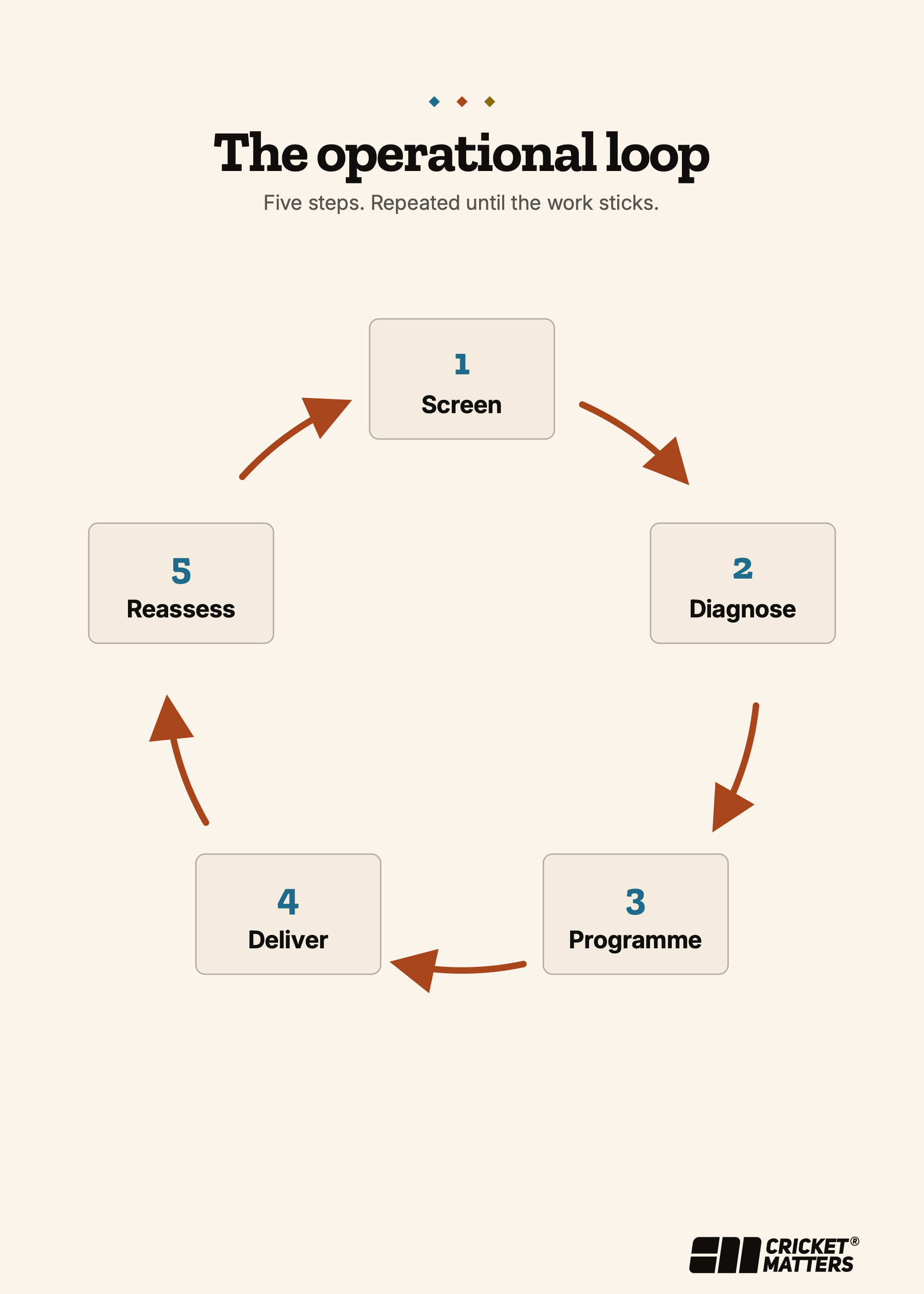
- Screen. Clinical assessment finds where in the Flywheel the athlete is stalled.
- Diagnose. Not “what hurts” but “which layer is the cause.”
- Programme. Rebuild from the layer that is actually stalled, not the layer showing the symptom.
- Deliver. The work itself — through clinic and programming.
- Reassess. Retest the layer that was stalled. Escalate to the next layer only when the work sticks.
The loop runs the same way for an eleven-year-old fast bowler in pain, a club cricketer trying to add ten miles an hour to their bowling, and an adult trying to play another five seasons without breakdown. The system is the same. The diagnosis differs.
Cricketers don’t need three practices. They need one system.
One system, applied across every level of the game.
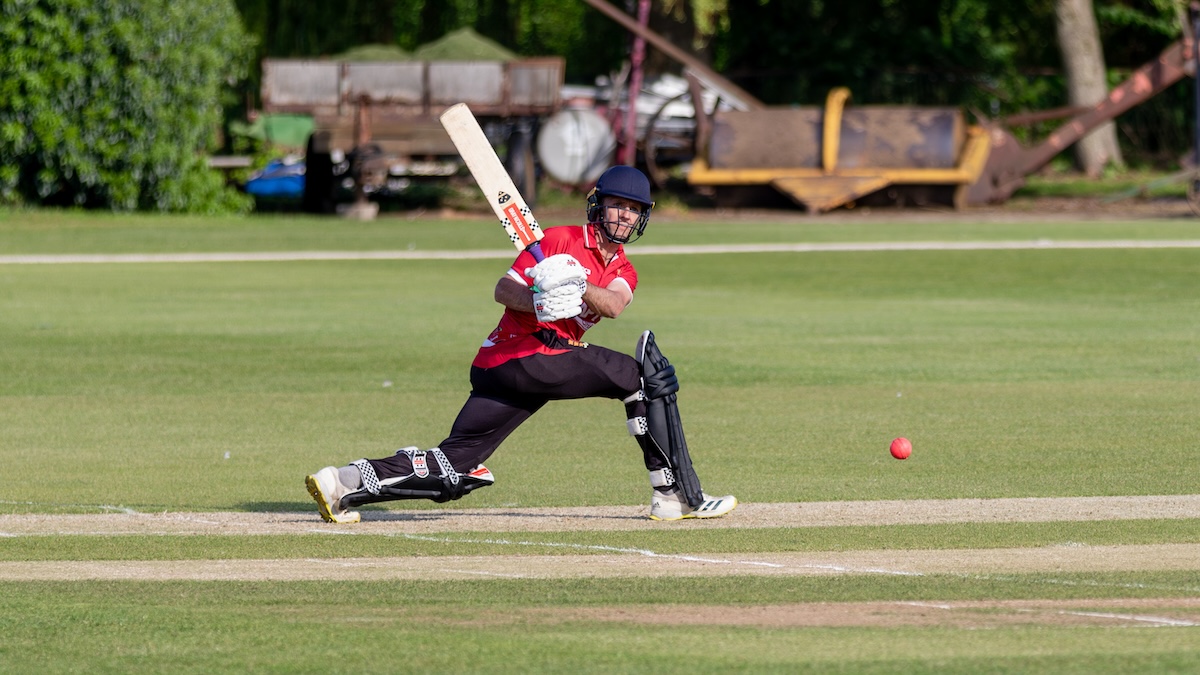
Every case reflects one of the six doors at the point of entry. The cricketer arrives with one statement — pain that won’t clear, fitness that won’t hold, a head that doesn’t survive the middle. The diagnosis differs every time. The system underneath does not.
The same system runs whether the cricketer is a club amateur, a professional, or an international side — men’s and women’s cricket alike. What changes is the diagnosis, never the method.
Each one is readable end to end. What survives real workloads, real selection pressure, real seasons. Read the case studies, or book a 20-minute clarity call if your situation is the question you want answered.
FAQs
Made in Wales. Applied everywhere.

The Cricket Matters System was built in Wales. It was developed inside real clubs, across real seasons, under real constraints and across international borders— the constraints cricketers actually carry from practice into matches. All players here juggle five things at once: work, family, selection pressure, travel and injury risk.
The system was shaped against those five. It had to land for the cricketer turning out for two teams after a forty-hour week, the parent who’s become a glorified taxi service, the returning player whose body has changed since their twenties, and the cricketer whose season runs across formats, time zones and borders.
What holds up here, holds up anywhere.

The Practitioner Behind the System
Built by Someone Accountable for the Decisions.
Cricket Matters isn’t a collection of services. It’s a performance system designed to guide better decisions — over seasons, not sessions.
I’m James Breese, founder of Cricket Matters and a sports therapist working at the intersection of coaching, training, and rehabilitation in cricket.
I’ve coached players.
I’ve prepared athletes.
I’ve treated injuries.
And I still play the game.
That matters — because the decisions inside this system aren’t theoretical. They’re based on what actually breaks players, what keeps them on the field, and what allows improvement to hold up in matches and across seasons.
Cricket Matters exists to remove guesswork. I’m accountable for the thinking behind it.
— James Breese
Founder, Cricket Matters
Choose Your Starting Point
Start in the Right Place.
Every cricketer starts with a free clarity call — to figure out together what makes sense next, before training, coaching, or assessment begins.
Twenty minutes. Free. No commitment.
Already a Client? Manage or Book Sessions Here