


James Breese | Founder, Cricket Matters
All clinical standards and performance work at Cricket Matters are overseen by James Breese — Level 5 Sports Clinical Therapist (LCSP Member No. 9390) and ECB Coach. Our integrated approach holds three perspectives at once — clinical, strength training, and cricket coaching — applied to athlete safety, injury rehabilitation, and performance under load.
Technique is a dependent variable. Force is what you build to express it.
Most cricketers chase pinnacle outputs (bowling speed, power hitting, high-intensity agility) before verifying whether the body can tolerate the load. The result is recurring injury, inconsistent output, and stalled development. The cricketer feels stuck. The coaches feel frustrated. The parent watching from the boundary feels confused about what to ask for next.
This post sets out Cricket Matters’ Standard Operating Procedure for tiered athletic development, what we call the Cricket Performance Pyramid. It defines the athletic-development sub-system within the broader Cricket Matters Performance System, and it answers the question most coaches and parents are actually circling: in what order does this work get built, and how is it calibrated to the cricketer who is actually in front of us?
The fuller methodology treatment, with worked clinical examples and the deeper implementation protocol, lives at the Cricket Matters Performance Engineering Blueprint. This piece sets out the Pyramid framework itself.
Table of Contents
The cycle most cricketers get stuck in
Most cricketers we see are top-heavy. Years of training the pinnacle on a body the load has outpaced. The result is a pattern most cricketers know from the inside.
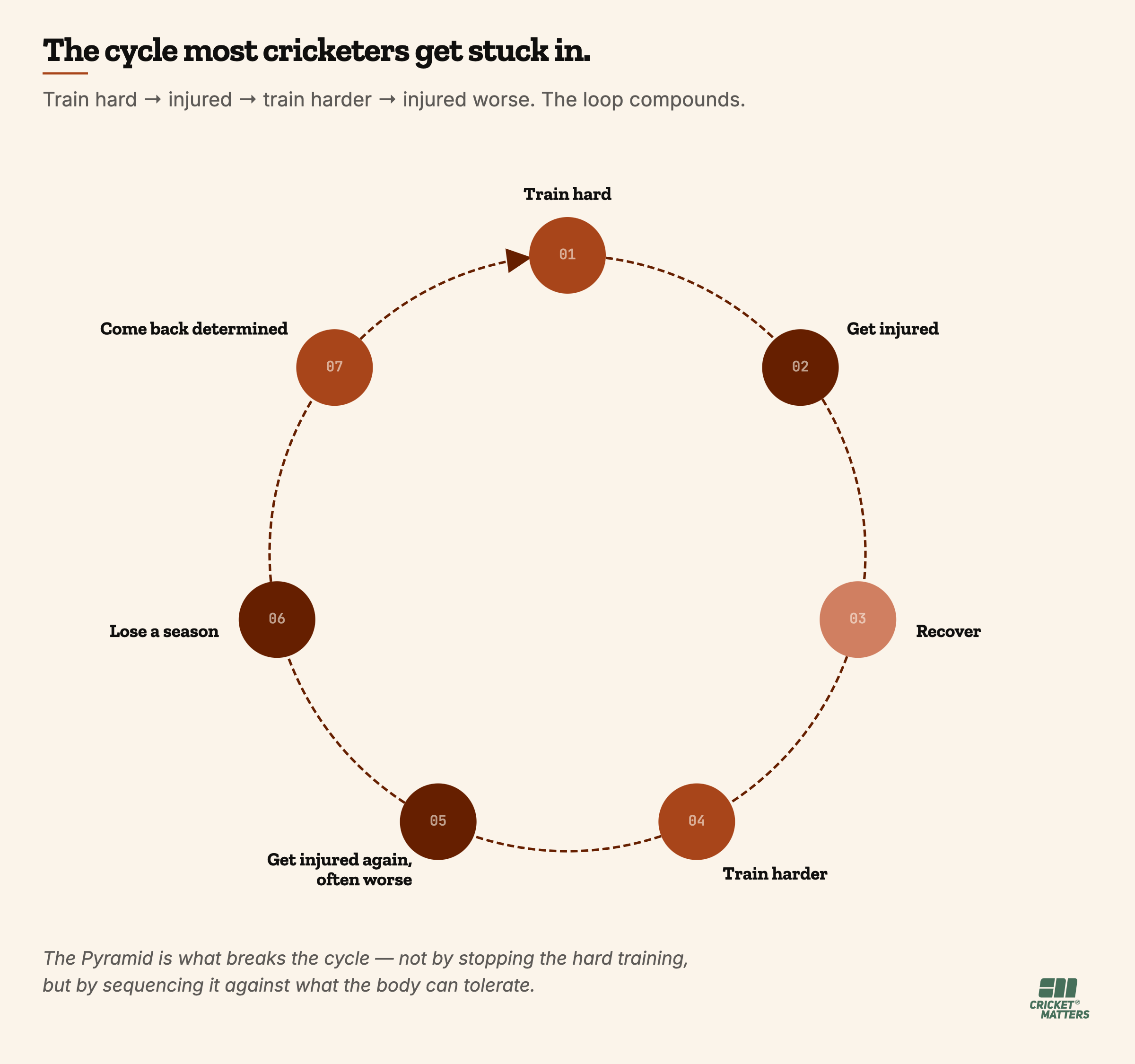
Train hard. Get injured. Recover. Train harder. Get injured again, often worse. Lose a season. Come back determined to make up for lost time. Train hardest. Get injured again.
Cricket culture rewards this. Fast bowling culture especially. The cricketer who pushes through pain is praised for being tough; the cricketer who pulls up short for a clinical assessment is questioned for being soft. The mythology says more is better, harder is better, and the body is the variable that must adapt to the load.
The evidence does not support that mythology. Previous injury is the strongest risk factor for future injury in sports (Kiesel, Butler and Plisky, 2014). Workload spikes against an underprepared body drive injury risk; well-prepared bodies tolerate higher chronic workload without it (Gabbett, 2016). In cricket fast bowlers specifically, back-pain risk is driven by workload, lumbopelvic control, and bowling-action movement patterns — all of which are modifiable, none of which are fixed by harder training alone (Singh, Baker and Egginton, 2025; Goggins et al, 2023).
The cycle does not mean the cricketer is undertrained. It means the cricketer is training the wrong things in the wrong order on a body the load has outpaced. The Pyramid is the framework Cricket Matters uses to break the cycle. The hard training continues. What changes is the sequence: built against what the body in front of us can actually tolerate.
The hierarchy of athletic development
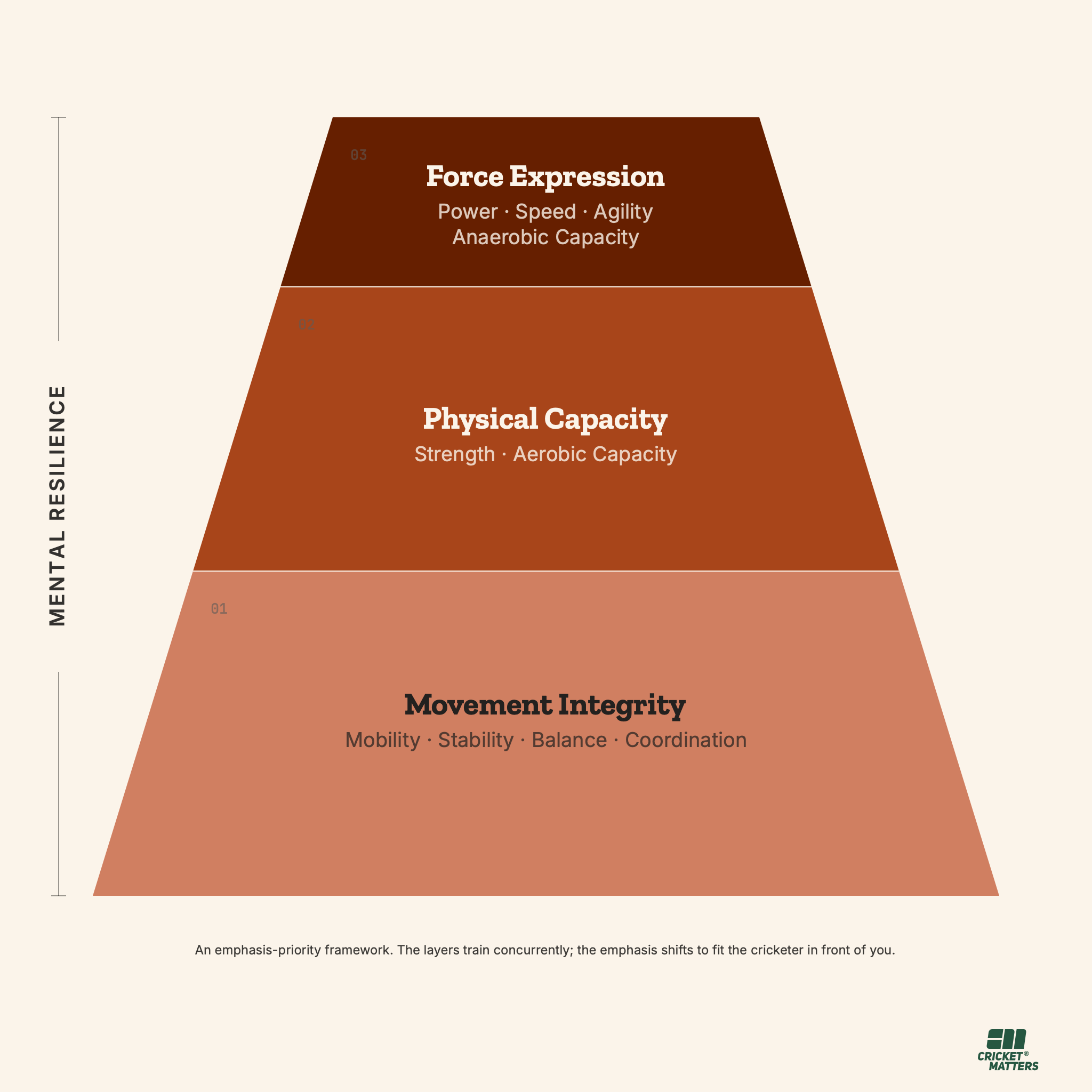
Technique is a dependent variable. It builds on the systems supporting it: movement integrity, physical capacity, and the body’s ability to express force under match-level load. When those underlying systems are developed in the right emphasis sequence for the cricketer in front of you, technique becomes the output it’s meant to be. When they aren’t, technique stays brittle no matter how many drills the cricketer runs.
The Cricket Performance Pyramid is the framework Cricket Matters uses to think about this. It draws on a recognisable practitioner-framework lineage: Bompa’s periodisation tradition, the joint-by-joint approach (Cook and Boyle), the Long-Term Athlete Development model (Balyi), and the Youth Physical Development model (Lloyd and Oliver, 2012). The contemporary evidence-informed position from the international sport-science consensus (Bergeron et al, 2015, IOC consensus; Lloyd, Faigenbaum et al, 2014) treats physical qualities as concurrently developable across the developmental span, with the emphasis shifting as the cricketer matures.
What this means in practice: the Pyramid is not invented from scratch. It draws on the work of the people who built this discipline. Where their positions converge (emphasis-mix shifts with maturation, layer progression supports but doesn’t gate), that’s the line Cricket Matters holds.
The Pyramid sits inside the broader Cricket Matters Performance Flywheel. It expands the Movement and Athleticism dimensions of the Flywheel into a three-layer build-emphasis architecture. Pyramid outputs (stable movement integrity, built load tolerance, verified technical output) feed back into the integrated five-pillar system the Flywheel describes.
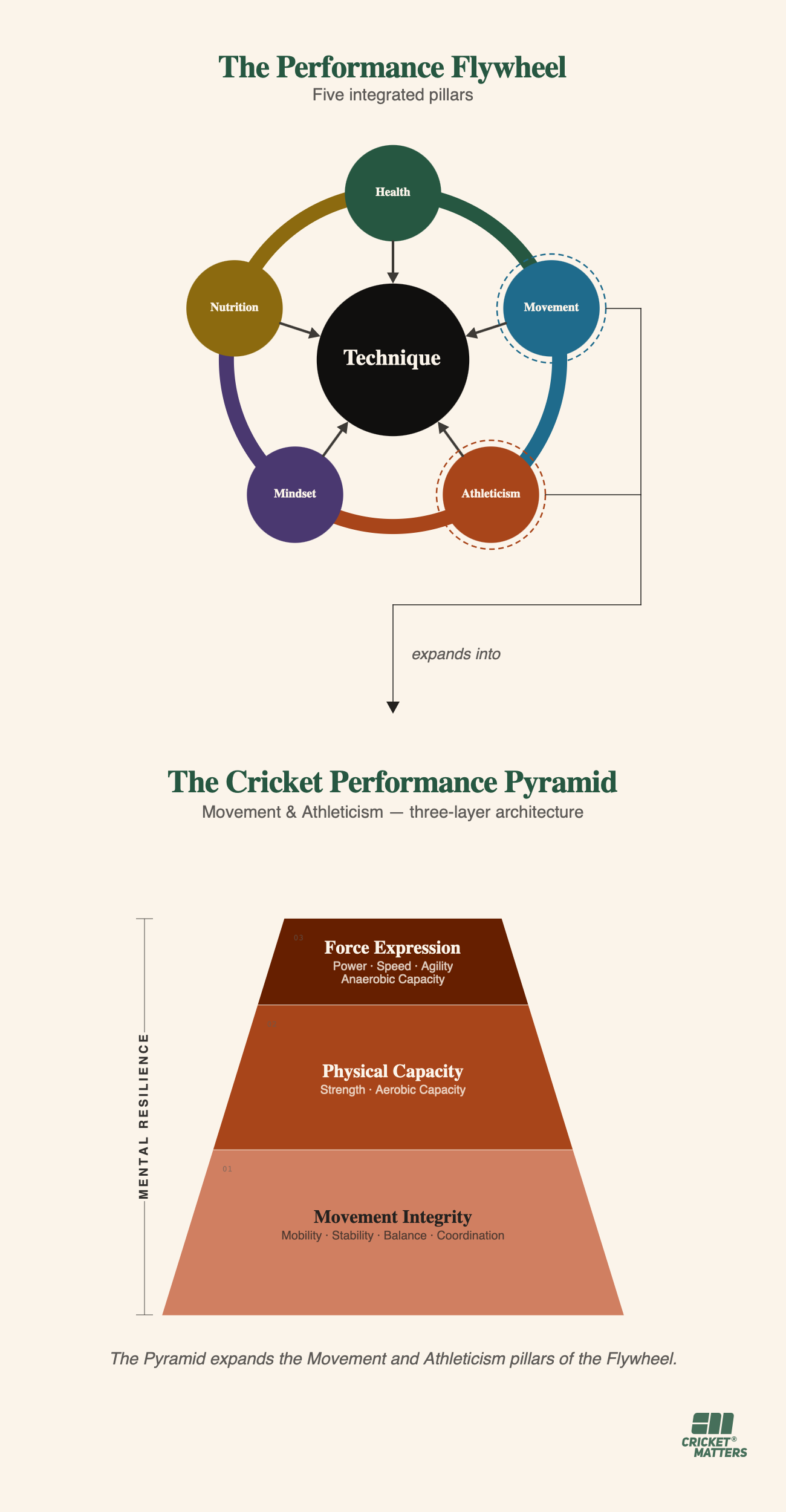
The Pyramid is not a checklist completed in order. It is an emphasis-priority framework calibrated to the cricketer in front of you.
Layer 1: Movement Integrity

Mobility, stability, balance, coordination. Layer 1 is about restoring the degrees of freedom and joint function that allow force to be expressed without compensatory leakage. At this level we identify the joint restrictions, compensatory movement strategies, and movement-pattern factors that produce inefficient force expression or increase injury risk.
In cricket fast bowlers specifically, the published evidence base confirms that lumbopelvic control and bowling-action movement patterns are real risk factors for back pain (Singh, Baker and Egginton, 2025; Goggins et al, 2023, ECB injury surveillance). The specific kinematic markers identified in cricket fast bowlers (lateral trunk flexion, knee angle at front-foot contact, peak vertical ground reaction forces; Arumugam et al, 2023) give Layer 1 work its clinical-anchoring targets.
What this looks like in practice. A bowler who keeps falling away in the second hour of a spell may be showing a hip-mobility restriction that the body compensates for through lumbar rotation. A batter who can’t stay balanced through the trigger movement may be working around a thoracic-rotation limit that no amount of stance cueing will fix. A spinner whose pivot collapses under fatigue may be losing knee-foot alignment because of an ankle-mobility deficit. None of these are technical problems. They are movement-integrity findings showing up as technical breakdowns.
Layer 1 work continues throughout a cricketer’s career. It is not a stage to be completed and left behind. The emphasis is heaviest pre-PHV (before peak height velocity, broadly the pre-pubertal years) when movement skill acquisition is the system’s most adaptive response. From that point on, Layer 1 work runs in parallel to everything else that follows.
Layer 2: Physical Capacity

Strength and aerobic capacity. Layer 2 is about building the biological substrate required to tolerate training volume, recover between sessions, and sustain output across the demands of a cricket season.
The objective at this layer is repeatability: the ability to absorb, recover from, and adapt to training and competition stress without volatility or regression. The capacity question is rarely about absolute strength. A bowler who can squat their bodyweight cleanly but loses bowling-action quality across the second hour of a long spell has not failed at Layer 2; they have flagged it. The Layer 2 work then targets work-capacity, eccentric tolerance, and recovery-rate development, alongside the Layer 1 work that keeps the underlying movement clean.
Layer 2 emphasis weights heaviest circa-PHV through post-PHV, broadly the pubertal and post-pubertal years. Younger cricketers can and should train these qualities; the evidence supports it (Lloyd, Faigenbaum et al, 2014, international consensus on youth resistance training). The shift is one of programming emphasis, not permission to begin.
For coaches: Layer 2 work is what makes a cricketer reliable across a season. They become a durable performer. The pace bowler who holds their action together across multiple spells. The batter who stays sharp late into an innings. The all-rounder whose throwing accuracy doesn’t drop at the end of a long day in the field. Layer 2 is what those cricketers are expressing without anyone naming it.
Layer 3: Force Expression

Power, speed, agility, anaerobic capacity. Layer 3 is the amplification stage. Once the movement system is stable and the biological substrate is load-tolerant, speed, power, and high-skill execution can be expressed efficiently. The same movement done with the same intent produces more output when Layers 1 and 2 underneath are in place.
Layer 3 modalities work in pre-PHV youth as well. Recent systematic-review evidence shows plyometric training produces equivalent improvements in pre-pubertal and post-pubertal youth, with some modalities favouring pre-PHV (Ramirez-Campillo et al, 2023). The contemporary picture is that Layer 3 training is not gated by Layer 2 development; the emphasis in the programming mix shifts by maturation, with the magnitude of adaptation typically smaller in pre-PHV than post-PHV (Kumar et al, 2025).
What Layer 3 amplifies depends on what is being asked of the cricketer at the level of cricket they are playing. A junior fast bowler chasing an extra five miles per hour expresses Layer 3 differently from an adult batter working on bat speed at the point of contact. The shared substrate underneath is the same: kinetic-chain force production routed through a body the assessment has verified can tolerate it.
Why everyone trains Layer 3 first

Most cricketers’ training looks the same. Speed work. Power hitting. Sprints. Bowling at the gun. High-intensity drills. The output measures (pace numbers, exit velocity, sprint times, power-clean weights) get posted on academy social feeds and worked on whenever you walk into a cricket room. Layer 3 work, almost exclusively.
Layer 3 looks like training. A bowler clocking 130+ km/h. A batter whose exit velocity is up. A fielder whose sprint time dropped. Observable, measurable, postable. Layer 1 work (restored thoracic rotation, balanced single-leg position, joint range that no longer compensates) looks like physio, like the warm-up someone is rushing through to get to the real session. Social media and academies reinforce that hierarchy. The cultural reward sits on the output side. The substrate side gets called pre-hab and skipped.
Building Layer 3 on top of an unaddressed Layer 1 deficit doesn’t bypass the deficit. It amplifies it. Every Layer 3 rep against a Layer 1 limitation reinforces the compensation the body is already running. The cricketer gets “faster” by recruiting more lumbar rotation through a hip that won’t move, or more trunk lean through an unbalanced base. The numbers improve. The body underneath gets worse. The failure mode is invisible until it lands as injury.
The Pyramid puts Movement Integrity at the bottom for a specific reason. It carries everything above. Force amplifies whatever sits underneath. Clean substrate, clean output. Dysfunctional substrate, amplified dysfunction. The top-heavy cricketer isn’t a coaching mistake — it’s a structural inversion of the architecture cricket performance actually depends on.
The Cricket Matters assessment surfaces Layer 1 state first. Layer 3 prescription comes after. Decisions about speed, power, and high-intensity drills are made with knowledge of what the body underneath can actually tolerate. Layer 3 work continues — cricketers still train hard, still chase pace, still build power. What changes is the order of the read. Substrate gets named before output.
The cost is paid at match day. Technique under match-day load is whatever Layer 3 has rehearsed. If those reps have been built on a Layer 1 deficit, the technique that emerges is compensation-built — the lumbar rotation substituting for hip mobility the bowler never got back; the trunk lean compensating for a single-leg base that never balanced. What looked like training was rehearsal of compensation. Technique is the dependent variable. What it depends on is whatever sits underneath the force.
How the system sequence works: assess first, engineer second
The Pyramid is governed by a three-line operating standard that runs through every Cricket Matters assessment and every Cricket Matters intervention:
Technique is not trained in isolation.
Output fails when the system cannot tolerate load.
Assess first. Engineer second.
These three lines say the same thing three ways, on purpose. The first names what technique is not: a standalone capability the cricketer can drill in isolation from the body that has to execute it. The second names what happens when the rule is broken: output collapses, often acutely, often at the moment it matters most. The third names the response: the assessment process identifies what the system is and is not capable of supporting; the intervention is then engineered against the actual constraint, not against the visible symptom.
Each Pyramid layer operationalises a piece of this standard. Layer 1 assesses and engineers movement integrity so the body can express force without leakage. Layer 2 assesses and engineers capacity so the body can tolerate that expression across cricket demand. Layer 3 amplifies what the other two layers have made possible — force expressed at match intensity. The work is sequential in emphasis even though all three layers run concurrently in practice.
Why observation-first coaching misses the mark
Most cricketers assess their game by watching themselves play. They look at how their batting looks, how their bowling feels, how many runs they’re scoring. Coaches do the same. They observe, make corrections, and work on technical refinements. The observation-first approach is the default across most cricket coaching contexts. It is also, more often than not, the reason the cricketer is stuck.
The problem is bias. Both players and coaches bring subconscious assumptions that influence what they focus on and how they interpret what they see.
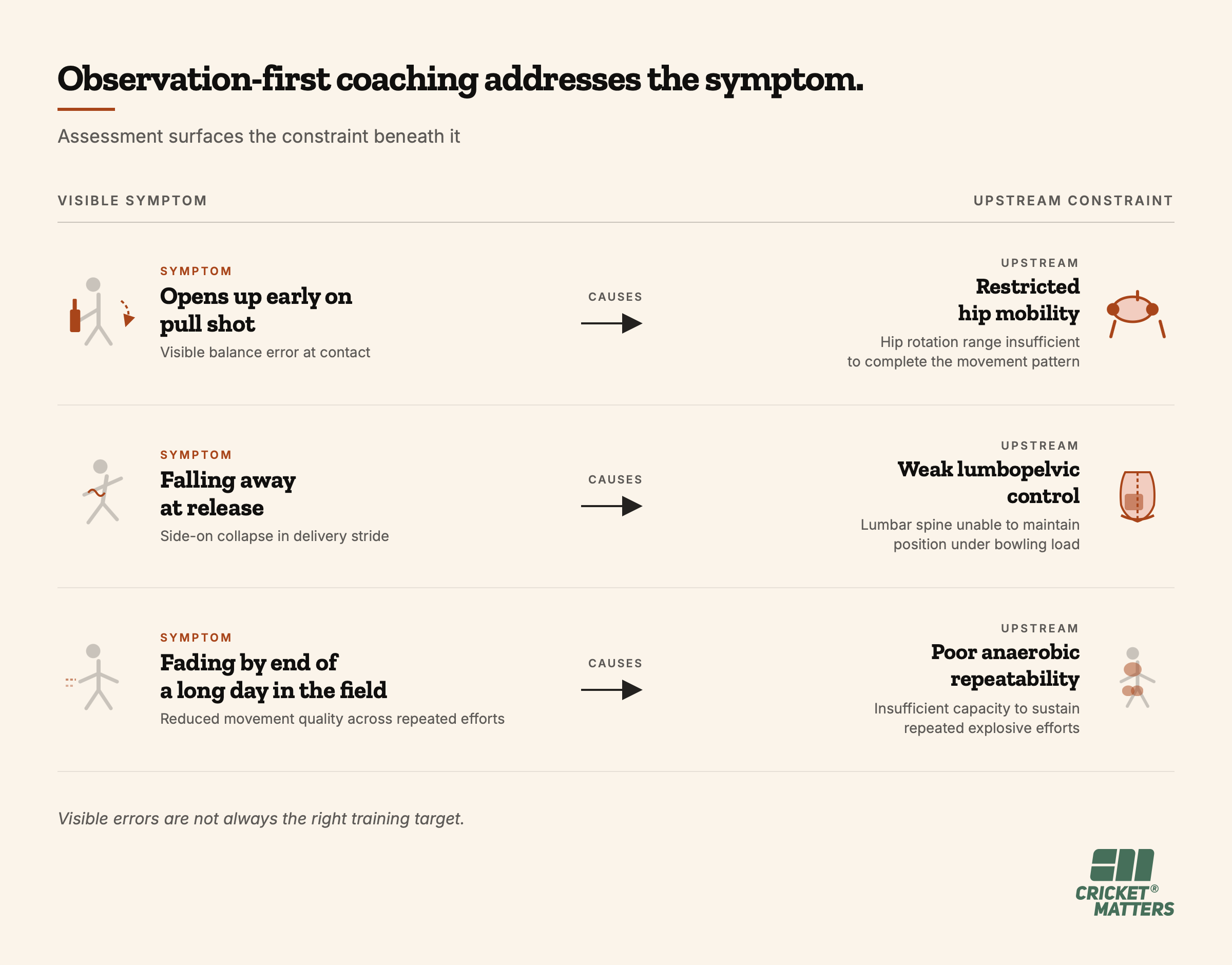
Player-side examples make the pattern concrete. A batsman who struggles against short-pitched bowling assumes they need to work on their backlift or reaction speed, when the real issue is poor thoracic mobility preventing a fluid bat swing. A bowler who loses pace thinks they need to tweak their run-up or arm action, when in reality they lack the lower-body strength to drive through the crease. A fielder who fumbles under pressure blames nerves, but poor sleep and hydration are slowing their reaction time. The cricketer’s self-diagnosis points at the visible problem. The actual constraint is upstream.
Coach-side examples follow the same shape. If a batsman keeps falling over to the off-side, a coach might say, “Stay more upright.” But if the player’s hip mobility is restricted, no amount of technical cueing will fix it. A coach focuses on a bowler’s wrist position when accuracy drops, but if core stability is weak, the bowler can’t maintain alignment through their action, making consistency impossible. A coach tells a slow-reacting fielder to “stay on your toes,” but if anaerobic fitness is poor, their ability to move explosively will always be compromised.
The Pyramid is the structural answer to this failure mode. It puts Movement Integrity before Physical Capacity before Force Expression in the order the assessment investigates the cricketer. The cricket-action stays the cricket-action, but the diagnostic frame moves underneath it. Surface errors are read as candidates for system-level constraints upstream, not as standalone technical faults to be drilled away.
The iceberg underneath
Most cricket performance is invisible. The runs, the wickets, the dot balls, the boundary-saves: that’s the visible 10% of the iceberg. The 90% underneath is what makes the visible 10% possible. Movement integrity. Physical capacity. Recovery state. Mental clarity. Fuelling. Sleep. Long-term load history. The bits nobody at the boundary sees, that govern everything they do.
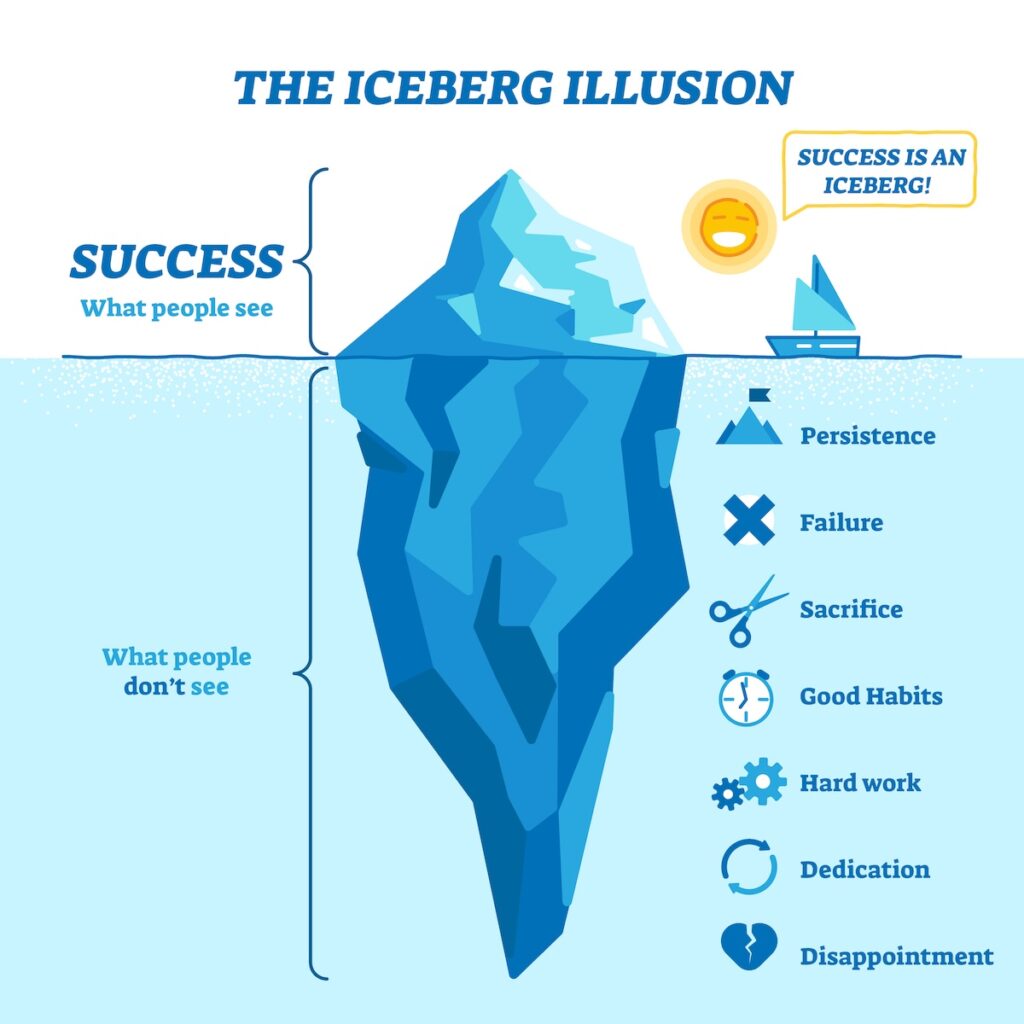
Surface errors are usually symptoms. Shot selection, balance, or loss of pace often reflect system limits, not isolated technical faults. The Cricket Matters SOP exists to identify the constraint before cues are applied.
The Pyramid is a structured map of that underwater 90%. Layer 1 is the deepest substrate, the structural integrity the rest of the iceberg sits on. Layer 2 builds the volume of the iceberg, the mass that absorbs and produces force. Layer 3 is the shape closest to the surface, the explosive expression that breaks above the waterline as visible performance. The cricketer the parent sees on Saturday is the tip. The Pyramid is the mass underneath that determines what shape the tip can take.
This is why two cricketers with similar visible technique can produce dramatically different outputs across a season. The visible 10% is similar. The underwater 90% is not.
How the Pyramid starts: the Cricket Matters assessment
Progress through the Pyramid is best supported by an assessment process that identifies which of the three layers carries the largest current opportunity for the individual cricketer, at the cricketer’s current stage of maturation and playing context.
The Cricket Matters Performance Assessment identifies this. It uses the FMS (Functional Movement Screen) and adjacent tools as movement-integrity assessment tools, not as injury-prediction tools. A composite FMS score of ≥ 14/21 with no individual scores of 0 or 1 is the threshold most commonly applied in adult collision-sport populations; the threshold’s predictive validity in junior cricketers specifically has not been established.
Martin, Olivier and Benjamin (2017) found the FMS did not predict injury in adolescent cricket pace bowlers (n=27). Moore et al (2019) reported OR 1.03 (not significant) in a junior-athletes meta-analysis. The broader Moran et al (2017) FMS meta-analysis reaches similar conclusions. What the screens reliably do is identify what to work on. What they do not reliably do is predict what will happen if it goes unworked.
The screen can be administered consistently between raters and across re-tests (Moran et al, 2015, reliability systematic review); reliability is a different question from predictive validity, and only the latter is contested.
Once assessed, the Pyramid is applied as a governed individualised pathway, not a single template. Each cricketer gets the emphasis-mix their current state warrants, calibrated to what the assessment found, what the cricket calendar is asking of them, and what maturation stage they are working through.
Mental Resilience as a cross-pillar property
Mental Resilience represents the system’s ability to maintain decision quality, emotional control, and execution stability under match-day load. Contemporary evidence treats it both ways, and both are real.
As an expression, mental resilience requires a foundation. When physical capacity or technical mastery breaks down, decision-making and composure are the first to degrade. The bowler at the back end of a long spell. The batter past the second hour of an innings. The mental side does not stand alone; it stands on what the body and the technique can still support.
As a trainable skill set, mental resilience also responds to its own deliberate development. Psychological skills training, mindfulness-based interventions (the Mindfulness-Acceptance-Commitment approach has a decade-review evidence base; Gardner and Moore, 2012), and structured reflection all have a contemporary evidence base supporting their independent effect on performance-relevant psychological outcomes. The meta-analytic evidence supports independent trainability with a large effect size (Stamatis et al, 2020). Cricket-specific applied work on captaincy, leadership, decision-making, and composure has carried this through to coaching practice (Cotterill and Barker, 2013).
The Cricket Matters integrated practice develops mental resilience both ways: through the physical and technical foundation that supports its expression, and through specific mental-skills work calibrated to the cricketer’s stage and needs.
Governing rule and maturation-stage modifier
If a cricketer cannot maintain movement quality and output stability under increasing load, the Cricket Matters assessment process identifies the underlying constraint and adjusts the programme.
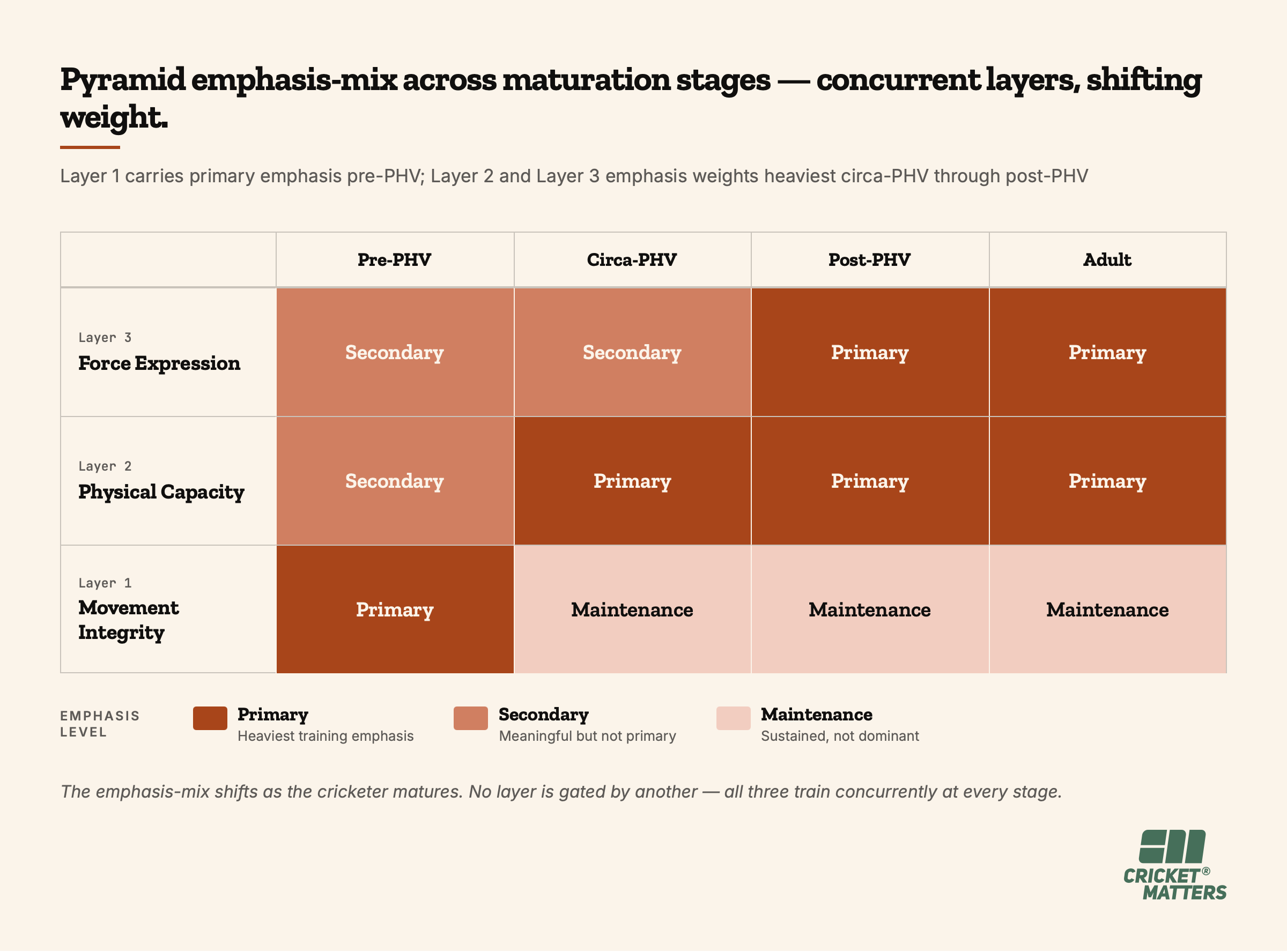
In return-to-play and clinical-rehabilitation contexts, this operates as a strict prerequisite for next-stage progression. The body has demonstrated it cannot tolerate the proposed load; the load is not applied until the underlying constraint is addressed. In routine youth athletic development contexts, the same rule operates as a strong programming preference informed by the assessment findings, with emphasis-priority adjusted to the cricketer’s maturation stage and individual constraints. The two-register difference is real. Clinical and rehabilitation work gates progression. Routine athletic development calibrates emphasis. The same principle governs both: the cricketer in front of us is the data, not the protocol.
Cricket Matters’ Pyramid application is also maturation-graded. Pre-PHV cricketers (broadly the pre-pubertal years) receive emphasis on movement-skill development and movement integrity, with concurrent capacity and output training at the developmentally appropriate dose. Circa-PHV and post-PHV cricketers (broadly the pubertal and post-pubertal years) see the emphasis-mix shift toward physical-capacity and technical-output development. This is consistent with the contemporary international evidence-informed position (Bergeron et al, 2015, IOC consensus; Lloyd and Oliver, 2012; Lloyd, Faigenbaum et al, 2014) and is operationalised through the Cricket Matters Performance Assessment.
How the Cricket Matters System plays out
A worked example is the cleanest way to see how the Pyramid actually runs in practice. The fuller treatment lives at the Cricket Matters Performance Engineering Blueprint, which carries an opening-batsman case study through assessment, intervention, and outcome at the level of depth a clinician or serious coach would want.
The short version: an opening batsman comes in frustrated, off-balance at the crease, struggling against short-pitched deliveries, assuming it’s a technical problem. Cricket Matters does not start with technique. The assessment surfaces limited thoracic mobility, tight hip flexors and adductors, weak core stability. The intervention addresses the physical limitations first: strength and conditioning, mobility work, manual therapy as required, four weeks dedicated to building the foundation. Four weeks later, the batsman’s balance is stable. His bat speed has increased because his rotational movement is more fluid. His reactions against pace have improved because he’s no longer compensating for physical restrictions. Only then does the technical work begin.
The load-bearing observation from the case: the outcome was not improvement from intervention. It was stability from correct sequencing. The Pyramid is what made the sequencing correct.
What this means for you
If you recognise the cycle in your own cricket or your child’s, the first step is to stop adding Layer 3 work on top of an un-assessed Layer 1 substrate. The Performance Assessment is what surfaces what’s actually underneath before the next decision gets made.
If you’re a parent of a junior cricketer trying to make sense of recurring injury or stalled progress, the Pyramid is the structure that gives the right next step shape. The free junior back pain guide is the starting point if back pain is in the picture.
If you’re an adult cricketer, a coach, or a clinician looking for the integrated approach to athletic development that Cricket Matters operates, the Cricket Matters performance system sets out the broader Flywheel the Pyramid sits inside, and the Engineering Blueprint goes deeper into the implementation protocol with worked clinical detail.
If you want to talk through where the body is right now and what the next move might be, book a clarity call — twenty minutes with James to talk through what is going on and what comes next.

What to do when your child’s back hurts.
Eleven conditions cricket can produce in a teenage spine. A seven-station home screen. A clear next step for every result.