
James Breese | Founder, Cricket Matters
All clinical standards and performance work at Cricket Matters are overseen by James Breese — Level 5 Sports Clinical Therapist (LCSP Member No. 9390) and ECB Coach. Our integrated approach holds three perspectives at once — clinical, strength training, and cricket coaching — applied to athlete safety, injury rehabilitation, and performance under load.
Fast bowling is not a spinal problem to fix. It is a movement system to understand.
Most approaches to back pain in cricket start at the site of symptoms. We start with the system that produced them.
Most approaches to back pain in cricket start at the site of symptoms. We start with the system that produced them.
This article outlines the model we use to assess and manage fast bowlers — not by chasing pain, but by identifying how force is produced, transferred, and absorbed across the body. The objective is simple: stop treating the symptom; start understanding the system.
Article summary
Low back pain in fast bowlers is often not primarily a lumbar spine issue. It is a movement-system problem showing up in the spine. This article walks through how force is produced and transferred during fast bowling, why the lumbar spine becomes overloaded, how restrictions in the hips, thoracic spine, or lower limbs increase spinal stress, how pain alters motor control even after it resolves, and why treating the site of pain alone often fails. The central idea: the spine is often the site of symptoms, not the source of dysfunction.
The spine is often the site of symptoms, not the source of dysfunction.
Table of Contents
Why Back Pain Keeps Coming Back
Low back pain is one of the most common issues in cricket fast bowlers. At junior, academy, and professional level, it shows up repeatedly — often at the same point in the season, and often in the same players.
The pattern looks like this. The bowler develops pain. They reduce or stop bowling. They receive treatment — manual therapy, rest, strengthening. Symptoms settle. They return to play. And within weeks or months, the pain returns.
That should raise a question. If the issue has been treated, why does it keep recurring?
Part of the answer lies in how the problem is defined. Most approaches focus on the lumbar spine — reduce pain, improve local strength, manage symptoms. This makes sense on the surface. The pain is in the back, so the back becomes the target. But this assumes the lumbar spine is the primary problem. That assumption is not always correct.
Junior fast bowlers in particular carry markedly elevated rates of lumbar bone-stress injury, tracking the loading side of the bowling action. Engstrom and Walker’s 2007 prospective MRI study found that 22% of adolescent fast bowlers developed symptomatic L4 pars stress lesions during a four-year follow-up, with all symptomatic L4 lesions developing between 15 and 17 years of age and all lateralised to the non-bowling-arm side. Keylock and colleagues’ 2022 cohort study in Journal of Sports Sciences confirmed the pattern in a larger sample of 14–17 year-olds — baseline LBSI prevalence of 20.5% and annual incidence of 27.3 per 100 players. Injured bowlers were older on average at the start of the preceding season than uninjured bowlers, suggesting LBSI risk coincides with the step-up in playing level during late adolescence.
Pain can settle, but performance doesn’t improve. Rehabilitation can stop, but the risk remains.
Across athletic populations more broadly, previous injury is one of the strongest predictors of future injury. This suggests something important: recovery is often incomplete. Not in terms of symptoms — but in terms of function.
Fast Bowling Is a Whole-Body Movement

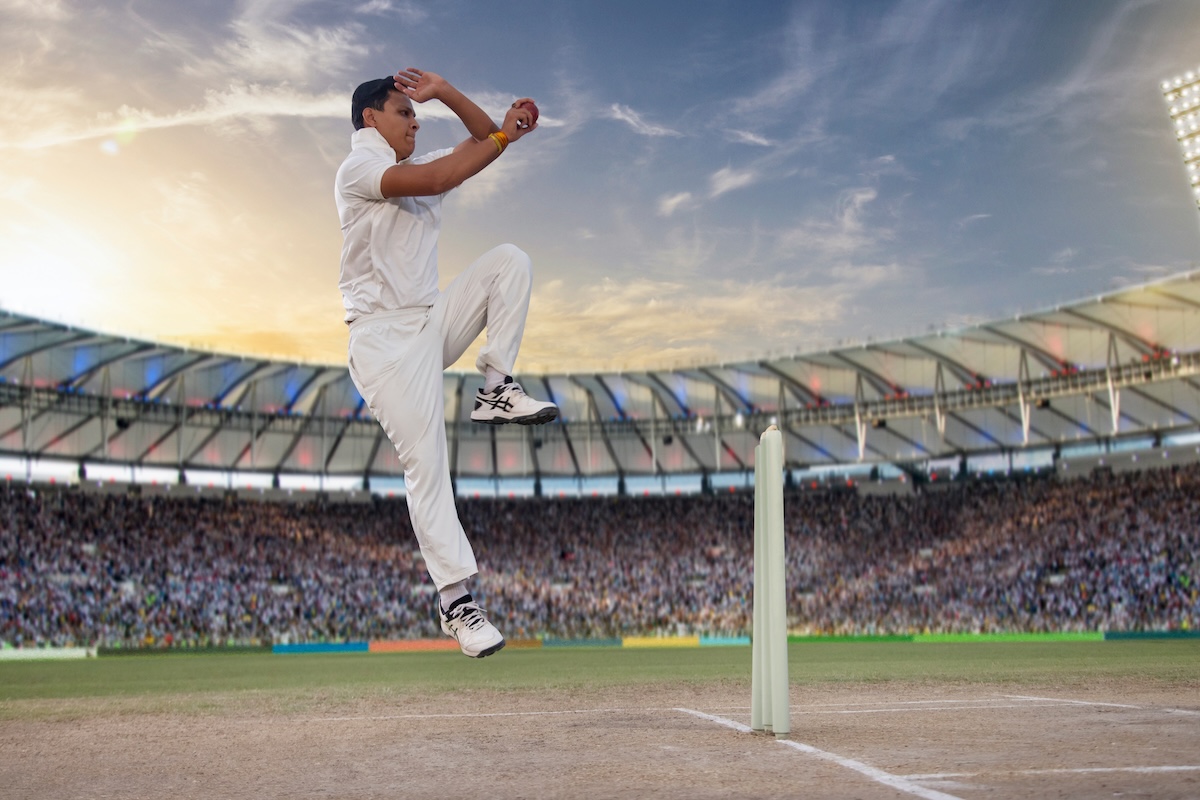
Fast bowling is a whole-body, high-velocity movement that relies on the coordinated transfer of force from the ground, through the body, and into the ball. The delivery is not a single action. It is a sequence: run-up → gather → delivery stride → release.
Each phase builds on the previous one. Ground-reaction forces of eight to ten times bodyweight are generated and absorbed at front-foot contact. The lower limbs and pelvis produce and regulate that force. Energy transfers through the trunk and into the upper body, before being expressed at the shoulder, arm, and hand at release. This is not a local movement. It is a linked system.
In biomechanics this is described as proximal-to-distal sequencing — force generated by larger, proximal segments and transferred to smaller, distal segments in a coordinated chain. When this sequence is efficient, velocity and accuracy improve while unnecessary stress is minimised. The principle has been well described across rotational sports (Putnam, 1993).
If one part of the system cannot contribute effectively, another part must compensate. If the ankle cannot absorb load, if the hip cannot rotate, if the thoracic spine cannot move, if the pelvis cannot control position — the system does not stop. It adapts. And when it adapts under speed and load, that adaptation often shifts stress to regions not designed to handle it repeatedly.
That is where the lumbar spine becomes relevant. Not as the primary driver of the movement, but as a transfer point within the system.
The Lumbar Spine — Built to Transfer Force, Not Create It
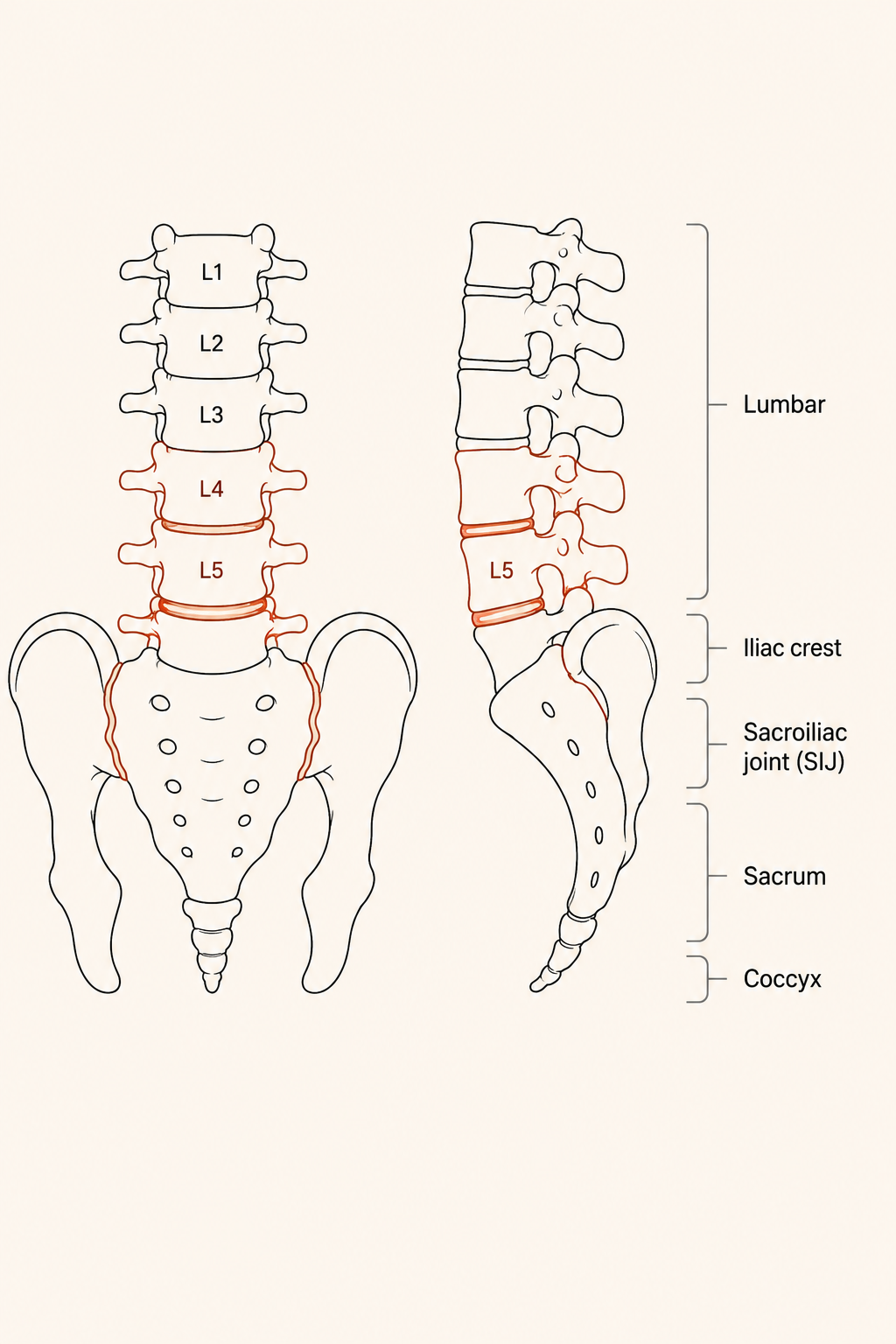
The lumbar spine is not built for large amounts of rotation. The orientation of the lumbar facet joints limits rotational movement to a small degree at each segment. Its primary role is to provide stability and allow force transfer between the lower and upper body — to control and transmit movement, not to create it (Panjabi, 1992).
In fast bowling, the spine is exposed to a unique combination of forces. The delivery stride loads the spine through extension, lateral flexion, and rotation simultaneously, at high speed, under repeated bowling volumes. These combined movements concentrate stress on the posterior elements of the spine — particularly the pars interarticularis, the small bony bridge in each lumbar vertebra.
This is not inherently a problem. The spine is capable of tolerating load — provided that load is appropriately distributed and remains within the capacity of the tissue. The issue arises when the lumbar spine is required to do more than its primary role. If the system below doesn’t generate or absorb force effectively, or the system above can’t express it efficiently, the lumbar spine has to contribute more to movement. That is where regional interdependence applies — dysfunction in one region alters loading patterns elsewhere.
The better question isn’t is the lumbar spine under load? It always is. The question is: is the lumbar spine operating within a system that supports efficient load transfer — or compensating for one that does not?
When the System Breaks Down, the Spine Pays the Price
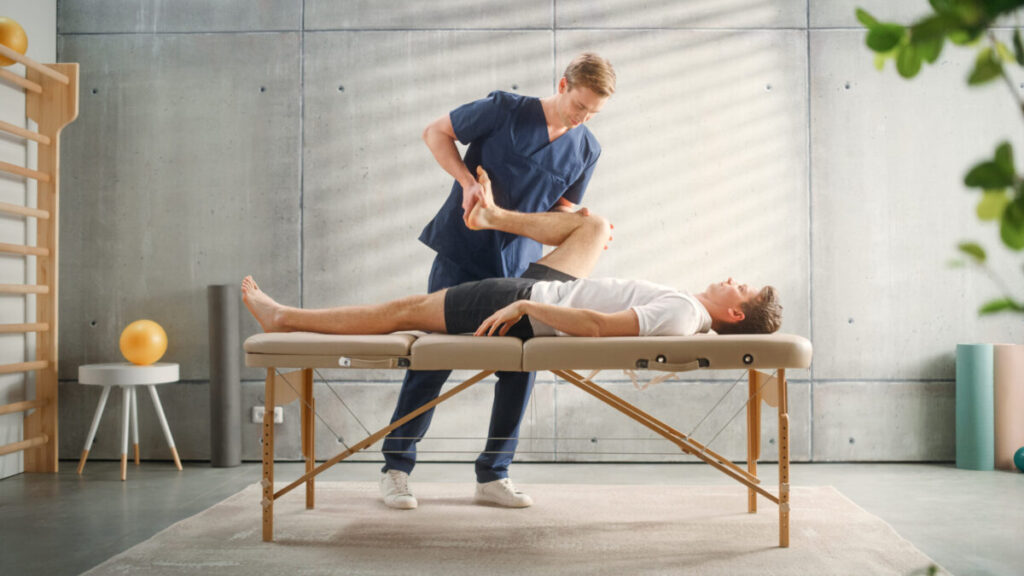
Force does not disappear. In fast bowling, it is generated, redirected, and transferred through the body at high speed. Once that process starts, the system has one job: manage and distribute that force efficiently.
Force does not disappear. The spine becomes the area where that inefficiency accumulates.
At a basic level, fast bowling depends on contribution from multiple regions. The ankle absorbs and redirects ground forces. The knee provides stability. The hip generates and transfers rotational force. The pelvis and trunk coordinate that transfer. The thoracic spine allows rotation and separation.
When each part contributes as expected, load is shared. When one part doesn’t, the system adapts. Restricted hip rotation can be associated with increased spinal motion. Limited thoracic mobility can lead to greater lumbar extension or lateral flexion. Reduced load absorption at the ankle can increase proximal loading demands. These relationships are consistent with the concept of regional interdependence (Wainner, 2007) — dysfunction in one region influences movement and loading in another.
The lumbar spine sits at a critical point in this system. It connects the lower and upper body. It is exposed to high forces. And it is often the region where compensations accumulate.
The exact way this happens varies between bowlers. One may compensate through increased lumbar extension. Another through lateral flexion. Another through altered timing and sequencing. There is no single pattern. The underlying principle stays consistent — when the system can’t distribute load efficiently, certain regions become exposed to more stress than they are designed to handle repeatedly.
The question shifts: not “where is the pain?” but “where is the system failing to manage load before the pain appears?”
How Restrictions in One Place Show Up in Another

The location of pain is not always the location of the problem.
The location of pain is not always the location of the problem.
In clinical practice, this is the difference between the source of symptoms and the cause of dysfunction. The source is where pain is felt. The cause is what is driving the movement or loading pattern that led to it. Those two are not always the same.
Regional interdependence describes how impairments in one part of the body influence movement, function, and loading in another. It is a recognised concept in musculoskeletal research reflecting the fact that the body operates as an integrated system rather than a series of isolated structures (Wainner, 2007).
There is growing evidence supporting relationships between regions. Thoracic spine restrictions have been linked to altered upper-body mechanics and shoulder dysfunction (Cleland, 2005). Reduced hip mobility has been associated with low back pain across multiple populations. These findings don’t demonstrate direct causation — but they do show that movement and load are shared across the system.
For fast bowling, this matters. The action places high simultaneous demand on lower-limb force production, pelvic control, trunk rotation, and upper-body coordination. If one region can’t contribute effectively, the system adapts. That adaptation changes how force is transferred, how movement is coordinated, and how load is distributed.
Focusing only on the site of pain risks missing the broader picture. A movement-based problem requires a movement-based assessment.
Mobility vs Stability — When the Body Compensates

The body is organised as an alternating sequence of mobile and stable segments — ankle for mobility, knee for stability, hip for mobility, lumbar spine for stability, thoracic spine for mobility. The model is a clinical framework rather than a predictive law, but the principle holds: if a joint that’s expected to move doesn’t move well, another region moves more to compensate. If a joint expected to stabilise can’t control movement, stability gets created elsewhere.
The system does not stop. It adapts.
In fast bowling specifically: if the hip cannot rotate effectively, rotation may increase through the lumbar spine. If the thoracic spine cannot contribute to rotation, the lumbar spine may extend or laterally flex more to achieve the same outcome. If the ankle cannot absorb load efficiently, demand on proximal segments increases.
These are not fixed rules. They will not apply identically to every bowler. They explain how movement adaptations occur when the system is constrained. In bowlers with back pain, this reframes the problem again. Not simply “is the lumbar spine moving too much?” — but “why might the lumbar spine be required to move more in the first place?”
What Pain Does to Movement (Even After It Has Gone)
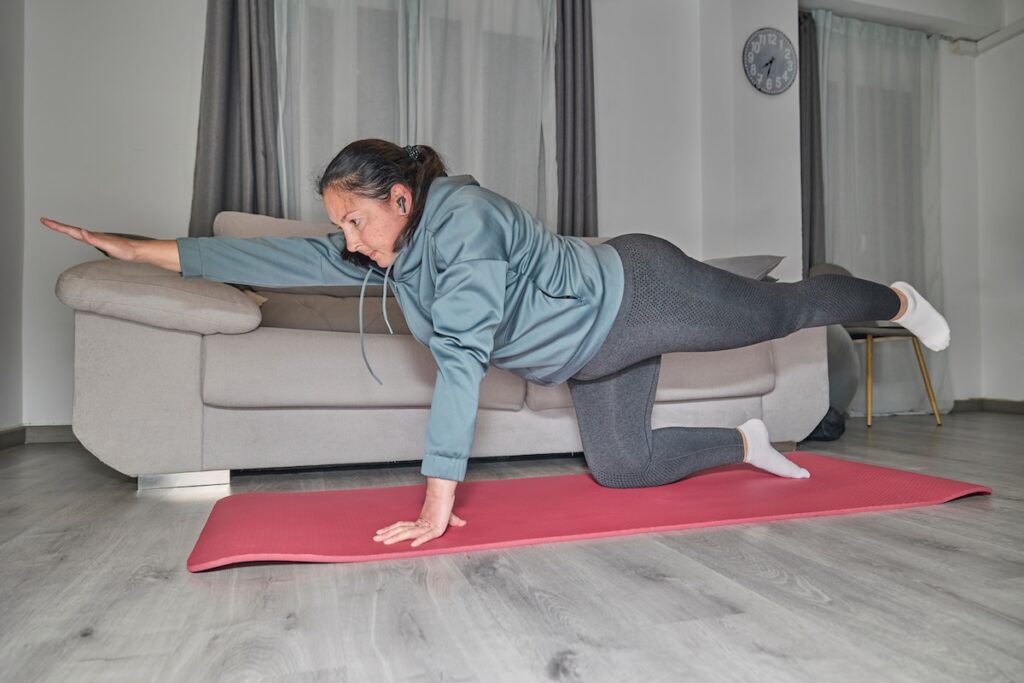
Pain is not just a symptom. It changes how the body moves.
When pain is present, the nervous system adapts. It alters muscle activation timing, coordination strategies, and how force is produced and controlled. Pain alters motor control rather than simply reducing activity — affecting both the timing and coordination of muscle activation (Hodges & Richardson, 1996).
In some cases, muscle activity reduces. In others, it increases. The system adjusts based on task, load, and perceived threat. What’s consistent is that movement changes.
These adaptations can persist even after symptoms have resolved. Pain-free individuals may still demonstrate altered movement patterns (Hodges & Moseley, 2003). Delayed activation of key trunk stabilisers has been observed long after symptoms have settled. Altered coordination patterns persist after return to activity.
Pain-free does not mean normal movement.
In low back pain populations specifically, the system often shifts toward more rigid, co-contraction strategies — more muscle activity but less efficient movement. Protective, not productive.
A bowler can be pain-free, cleared to return to play, back in full training — and still operating with an altered movement strategy. When that strategy is exposed to the demands of fast bowling, the system reverts to what it has learned. If that strategy redistributes load differently or relies on compensation, the same region may be exposed to the same stress that produced pain the first time.
Rehabilitation is not just about reducing pain. It is about restoring how movement is organised.
Breathing, Bracing, and Spinal Control

At the centre of trunk control sits the diaphragm.
Commonly thought of as a respiratory muscle, the diaphragm also plays a role in trunk stability, intra-abdominal pressure regulation, and coordination with other stabilising structures. It contributes to postural control independently of respiration, and helps stabilise the spine through pressure regulation (Hodges & Gandevia, 2000).
The diaphragm doesn’t work in isolation. It interacts with the pelvic floor, the abdominal wall, and the deep spinal stabilisers — an integrated neuromuscular system rather than isolated muscles (Panjabi, 1992).
For fast bowling, this matters. The action involves rapid force production, high ground-reaction forces, and repeated loading through the trunk. For that force to transfer efficiently, the trunk must be able to stabilise at the right time, allow movement where needed, and manage pressure effectively. If this system isn’t functioning well, control is affected — excessive rigidity, poor timing of muscle activation, inefficient force transfer.
The honest position: there is currently limited sport-specific research directly linking breathing mechanics to lumbar spine injury in fast bowlers. The role of breathing should not be overstated. It is one component in a broader system, not the sole driver of performance or injury.
What it offers is another layer of understanding. The question is not just “is the spine strong enough?” but “is the system organising and controlling the trunk effectively under load?”
The Missing Link in Rehab
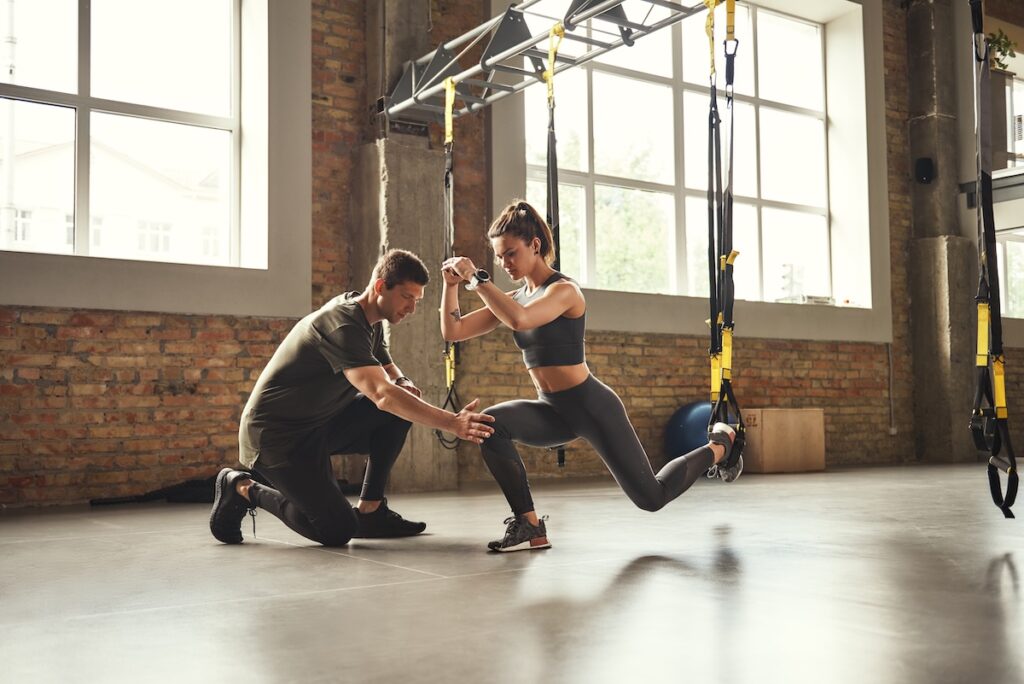
Control refers to how movement is organised — coordination, sequencing, timing of muscle activation, the ability to stabilise and move at the right moment. Motor control deficits have been consistently observed in low back pain populations (Hodges & Richardson, 1996; Hodges & Moseley, 2003).
Capacity refers to what the system can tolerate — strength, endurance, tissue tolerance, the ability to repeatedly absorb and produce force. Injury risk is strongly influenced by the relationship between load and tissue capacity. Spikes in workload increase injury risk when capacity is exceeded (Gabbett, 2016).
Both are required. They are not the same thing.
The common problem in practice: athletes develop one without the other. Some have capacity without control — strong, but poorly coordinated, reliant on compensation under speed and fatigue. Others have control without capacity — they move well in controlled environments, but lack the strength to tolerate repeated high-load activity.
You can’t out-train dysfunction. You also can’t move your way out of an undertrained tissue.
In fast bowling, both are needed at high level. If control is poor, load is not distributed efficiently. If capacity is insufficient, even well-distributed load cannot be tolerated. The athlete returns to play with improved symptoms, partial adaptation, but without a system that can both organise movement and tolerate load at the required level.
The standard that matters isn’t “is the athlete strong enough?” or “does the athlete move well?” It’s both: can the athlete organise movement effectively and tolerate the load the sport demands?
Why Treating the Back Alone Often Fails
Most approaches to low back pain in fast bowlers are built around the site of symptoms — rest, manual therapy, core strengthening. Each has value. Rest can reduce irritation. Manual therapy can help with symptom relief and short-term movement changes. Strengthening can improve local capacity.
But despite this, recurrence remains common. Across the cricket literature, previous lumbar injury is one of the strongest predictors of future lumbar injury. Across the broader low back pain literature, exercise therapy improves pain and function but its effects on long-term recurrence are more variable (Hayden, 2005; Ferreira, 2006).
In other words: athletes may feel better, but still be vulnerable.
This doesn’t mean local treatment is ineffective. It plays an important role — reducing symptoms, improving tolerance to movement, creating a window for rehabilitation. But on its own, it is often insufficient. The problem isn’t always located solely in the back. It is often in how the system loads the back.
If the underlying movement patterns, coordination strategies, and load management are unchanged, the same stress will be applied in the same way. The outcome is predictable.
The shift: not “fixing the back”, but changing how the system produces and manages load.
The Cricket Matters Model — Protect, Correct, Develop

A useful framework for organising rehabilitation in fast bowlers: Protect. Correct. Develop.
Protect — manage load. Reduce aggravating factors. Modify bowling volume, intensity, and frequency. Spikes in workload are associated with increased injury risk, and managing load over time is critical for reducing it (Gabbett, 2016). Protection is not complete rest. It is creating an environment where the system is no longer being overloaded while maintaining enough stimulus to avoid deconditioning.
Correct — restore how the system moves. Restore mobility where it is limited. Improve motor control and coordination. Address breathing and trunk control. Motor control deficits can persist following injury and influence how movement is organised even after symptoms have resolved (Hodges & Moseley, 2003). The aim is not to chase isolated deficits but to improve how the system produces movement, transfers force, and organises itself under load.
Develop — build capacity. Strength, endurance, tissue tolerance, the ability to repeat high-load actions. Tissue adaptation requires progressive exposure to load. Without it, capacity doesn’t improve. With excessive or poorly managed load, injury risk increases. The load–capacity relationship is central to both performance and injury prevention (Gabbett, 2016).
These aren’t separate phases. They are overlapping processes. An athlete may need ongoing load management, continued movement correction, and progressive capacity development at the same time.
Protect without correct — symptoms settle, but movement stays unchanged. Correct without develop — movement improves, but load can’t be tolerated. Develop without control — capacity increases, but inefficient patterns persist.
The model isn’t complex. It is usable — a way to structure rehabilitation, guide decision-making, and adapt to different athletes and contexts.
What This Means for Fast Bowlers, Coaches, and Parents
For fast bowlers
Don’t chase symptoms alone. Reducing pain is important, but it isn’t the end point. Changes in motor control and movement strategy can persist after symptoms resolve, meaning you can be pain-free but still moving differently (Hodges & Moseley, 2003). Injury risk is influenced by how load is managed relative to capacity — spikes in workload, or returning to high demand without adequate preparation, increase the likelihood of injury (Gabbett, 2016).
The question shifts from “is my back better?” to “is my system better able to handle the demands of fast bowling?”
For coaches
Technique doesn’t exist in isolation. It is influenced by mobility, strength, coordination, and fatigue. A technical change the body can’t support won’t hold under pressure. A physical limitation will influence how technique is expressed.
Technical coaching and physical development have to work together. The implication for the way you build a fast bowler isn’t to pick between them — it is to coordinate them.
For parents
Adolescent fast bowlers are particularly vulnerable to lumbar stress injuries. The peak risk window sits between 15 and 17 years of age (Engstrom & Walker, 2007; Keylock et al., 2022), and incidence tracks the step-up to senior teams in late adolescence. Early MRI markers such as bone marrow oedema can appear before more serious injury develops.
Problems often develop before symptoms become obvious. The value sits in early assessment, appropriate workload management, and developing movement quality alongside skill. Not to prevent all injury — which is unrealistic — but to reduce unnecessary risk and support long-term development.
The parent’s guide to back pain in junior fast bowlers covers the full differential — what cricket can produce in a teenage spine — and the seven-station home screen that comes with the guide.
You can also download the Junior Back Pain Screening Guide as a PDF — the same seven-station home screen, printable, takes ten minutes.
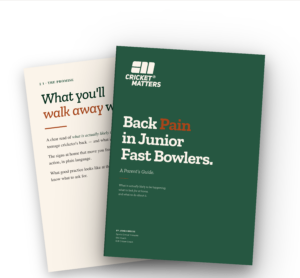
What to do when your child’s back hurts.
Eleven conditions cricket can produce in a teenage spine. A seven-station home screen. A clear next step for every result.
The takeaway
Across all three groups, the message is consistent. Back pain in fast bowlers should not be viewed purely as a local problem. It is often a reflection of how the system manages load. Not just a problem to treat — a signal that something in the system is not working efficiently. Addressing the symptom may reduce pain. Understanding the system is what reduces risk.
Evidence Corner
This article presents a movement-system model of back pain in fast bowlers. No single study proves the model in full. Multiple areas of research support its key components — fast-bowler lumbar bone-stress epidemiology, motor control adaptation after pain, load-vs-capacity dynamics, regional interdependence, kinetic chain mechanics, and trunk control.
What It Does Well
- Junior fast bowlers carry markedly elevated rates of lumbar bone-stress injury, particularly in the 15–17 age window, tracking the loading side of the bowling action (Engstrom & Walker, 2007; Keylock et al., 2022).
- Adolescent fast bowlers in English County cricket show high lumbar stress fracture incidence and recurrence rates over multi-season follow-up (Alway et al., 2019).
- Efficient performance in rotational sports depends on coordinated proximal-to-distal energy transfer across body segments; disruption in one segment alters how load is transferred through the chain (Putnam, 1993).
- The lumbar spine operates within a multi-subsystem stabilising architecture — passive, active, and neural control elements that have to coordinate for safe movement (Panjabi, 1992).
- Pain alters motor control beyond simple muscle inhibition — coordination, timing, and movement strategy change, and these adaptations can persist after symptoms resolve (Hodges & Richardson, 1996; Hodges & Moseley, 2003).
- The diaphragm contributes to trunk stability independently of respiration through intra-abdominal pressure regulation (Hodges & Gandevia, 2000).
- Injury risk is strongly influenced by the relationship between applied load and the system’s ability to tolerate it; spikes in workload significantly increase risk when capacity is exceeded (Gabbett, 2016).
- Impairments in one region influence movement, function, and loading in another — the concept of regional interdependence (Wainner, 2007). Thoracic mobility specifically has documented influence on neck and shoulder mechanics (Cleland, 2005).
- Exercise therapy improves pain and function in chronic low back pain, though long-term recurrence is more variable (Hayden, 2005; Ferreira, 2006).
Where It Falls Short
- Limited cricket-specific research on breathing mechanics, fascial chain function, and trunk control in the bowling action specifically. Most supporting evidence transfers from general musculoskeletal and broader sports populations.
- The integration of these elements into a single movement-system model is a clinical reasoning framework rather than a fully-proven unified theory. Direction is supported; precise mechanisms are still under investigation.
- Mechanistic uncertainty — the what (movement adaptation, motor control change, load-capacity dynamics) is clearer than the why in many cases.
What This Means for Cricketers
Most cricket-related back pain originates outside the spine — in how force travels through the kinetic chain. When the system loses coordination, load distributes differently and certain regions take stress they are not designed to handle repeatedly. The most effective fix isn’t more “core work” — it’s restoring how the system organises movement, manages load, and recovers between exposures.
Key Research References
- Engstrom, C. M., & Walker, D. G. (2007). Pars interarticularis stress lesions in the lumbar spine of cricket fast bowlers. Medicine & Science in Sports & Exercise, 39(1), 28–33. doi: 10.1249/01.mss.0000241642.82725.ac.
- Keylock, L., Alway, P., Felton, P., McCaig, S., Brooke-Wavell, K., King, M., & Peirce, N. (2022). Lumbar bone stress injuries and risk factors in adolescent cricket fast bowlers. Journal of Sports Sciences, 40(12), 1336–1342. doi: 10.1080/02640414.2022.2080161.
- Alway, P., Brooke-Wavell, K., Langley, B., King, M., & Peirce, N. (2019). Incidence and prevalence of lumbar stress fracture in English County Cricket fast bowlers, association with bowling workload and seasonal variation. BMJ Open Sport & Exercise Medicine, 5(1), e000529. doi: 10.1136/bmjsem-2019-000529.
- Putnam, C. A. (1993). Sequential motions of body segments in striking and throwing skills: descriptions and explanations. Journal of Biomechanics, 26 Suppl 1, 125–135. doi: 10.1016/0021-9290(93)90084-r.
- Panjabi, M. M. (1992). The stabilizing system of the spine. Part I. Function, dysfunction, adaptation, and enhancement. Journal of Spinal Disorders, 5(4), 383–389. doi: 10.1097/00002517-199212000-00001.
- Hodges, P. W., & Richardson, C. A. (1996). Inefficient muscular stabilization of the lumbar spine associated with low back pain: a motor control evaluation of transversus abdominis. Spine, 21(22), 2640–2650. doi: 10.1097/00007632-199611150-00014.
- Hodges, P. W., & Moseley, G. L. (2003). Pain and motor control of the lumbopelvic region: effect and possible mechanisms. Journal of Electromyography and Kinesiology, 13(4), 361–370. doi: 10.1016/s1050-6411(03)00042-7.
- Hodges, P. W., & Gandevia, S. C. (2000). Activation of the human diaphragm during a repetitive postural task. Journal of Applied Physiology, 89(3), 967–976. doi: 10.1152/jappl.2000.89.3.967.
- Wainner, R. S., Whitman, J. M., Cleland, J. A., & Flynn, T. W. (2007). Regional interdependence: a musculoskeletal examination model whose time has come. Journal of Orthopaedic & Sports Physical Therapy, 37(11), 658–660. doi: 10.2519/jospt.2007.0110.
- Cleland, J. A., Childs, J. D., McRae, M., Palmer, J. A., & Stowell, T. (2005). Immediate effects of thoracic manipulation in patients with neck pain: a randomized clinical trial. Manual Therapy, 10(2), 127–135. doi: 10.1016/j.math.2004.08.005.
- Hayden, J. A., van Tulder, M. W., Malmivaara, A., & Koes, B. W. (2005). Exercise therapy for treatment of non-specific low back pain. Annals of Internal Medicine, 142(9), 776–785. doi: 10.7326/0003-4819-142-9-200505030-00014.
- Ferreira, M. L., Ferreira, P. H., Latimer, J., Herbert, R. D., & Maher, C. G. (2006). Efficacy of specific stabilisation exercise for spinal and pelvic pain: a systematic review. Australian Journal of Physiotherapy, 52(2), 79–88. doi: 10.1016/s0004-9514(06)70043-5.
- Gabbett, T. J. (2016). The training-injury prevention paradox: should athletes be training smarter and harder? British Journal of Sports Medicine, 50(5), 273–280. doi: 10.1136/bjsports-2015-095788.
Bottom Line for Cricketers
Back pain in fast bowlers isn’t always a back problem — it’s usually a movement-system problem. When the system reconnects from feet through hips and thorax to shoulders, the spine can do its real job: stay stable while the rest of the body produces, transfers, and absorbs force the way the action demands.
FAQ
How do you fix lower back pain from fast bowling?
Start by reducing or modifying the bowling load — give the tissue a window to settle without going into complete rest. Then assess why the back is being overloaded rather than only treating the painful area. In most bowlers, the problem also involves hips, thorax, lower-limb control, or bowling mechanics. If pain is sharp, recurrent, one-sided, or worsening, get assessed properly to rule out more serious causes such as lumbar bone-stress injury — particularly in the 15–17 age window.
Why does bowling make my back hurt?
Fast bowling puts repeated stress on the lower back through extension, rotation, side-flexion, and front-leg braking. Your back may hurt because it is taking more load than it can tolerate — either because bowling volume has spiked, or because other parts of the system (ankle, hip, thorax) aren’t sharing the work well. In young fast bowlers, persistent back pain should be taken seriously.
Can hip stiffness cause lower back pain in fast bowlers?
It can contribute. If the hips cannot rotate or extend well, the lower back may compensate during the bowling action. Hip stiffness is unlikely to be the only cause, but it is one of several movement factors worth screening when a fast bowler has recurring back pain.
What should be screened in a fast bowler with back pain?
A proper screen should look beyond the lumbar spine. It includes pain history, bowling workload, hip movement, thoracic rotation, lower-limb control, ankle function, and bowling mechanics. Further medical assessment is warranted if symptoms suggest a bone-stress or nerve-related problem.
Is rest alone enough to fix back pain in fast bowlers?
Usually not. Short-term load reduction may help calm symptoms, but prolonged rest alone often does not solve the reason the pain developed and can slow recovery. Most non-serious back pain improves better with appropriate movement, gradual reloading, and a clear return-to-bowling plan.
How is junior back pain different from adult back pain?
The bone is the main difference. In adults, back pain is usually a soft-tissue or disc question. In juniors aged 11–17, the bone itself is still mineralising. The pars interarticularis — the small bony bridge in each lumbar vertebra — sits in a vulnerable window where it is still building structure. Push too hard with a movement pattern that funnels load into the spine, and the bone can develop a stress reaction. That’s why “growing pains” is often the wrong framing — it is the bone signalling load, not the body adapting to growth (Engstrom & Walker, 2007; Keylock et al., 2022).