
James Breese | Founder, Cricket Matters
All clinical and performance work at Cricket Matters is overseen by James Breese: Sports and Clinical Therapist, Strength and Conditioning Coach, Sports Nutrition Coach, and ECB Cricket Coach. The Cricket Matters System connects training, coaching, nutrition, and recovery into one clear plan, to build high-performing, durable cricketers.
There isn’t one fitness test in cricket. Each board, county and state runs its own set of tests, and the 2 km time trial is the one that keeps turning up. You can’t run a professional testing day at home, and you don’t need to. You can test the same qualities with a tape measure, a stopwatch and a bar.
Before a testing day, players ask us the same three things.
- Does this decide whether I make the team?
- What’s a good score for someone like me?
- And what happens if I miss it?
This page answers all three. For training methods that move these testing numbers forwards, start with our strength training guide for cricketers.
Table of Contents
There is no single fitness test in cricket
Each board picks its own tests, and the set changes over time, so every row below carries its source and year.
| Board or team | Tests on record |
|---|---|
| England men, first-class counties The Athletic, 2026 | A body-fat measure (skinfold callipers at eight points on the body), a 40 m sprint with a time also taken at 20 m, and a 2 km time trial, listed in a report from inside a county testing day as the three every first-class county must run |
| England women, senior team Peer-reviewed study, 2025, covering 2010 to 2022 | 10 m and 20 m sprints, a jump, the Yo-Yo test, timed push and pull endurance, and from 2018 a cricket-running test (Run-2) |
| India (men) ESPNcricinfo, 2021 | Yo-Yo test to level 17:1 (a set stage on the test’s beep track), or a 2 km time trial as the alternative: 8:15 for fast bowlers, 8:30 for everyone else. Players had to clear one of the two |
| South Africa ESPNcricinfo, 2023 | A 2 km fit-to-play standard of under 8:30 for men and under 9:30 for women, and a faster target of under 7:45 and under 9:00 that it wants all its professionals to reach. Since 2023 not applied rigidly as a selection rule: head coaches decide |
| Used in Australian cricket testing cricket.com.au (Cricket Australia video), 2019 | Run-a-Three: three pitch lengths (about 53 m) with two turns, carrying a bat |
| Lancashire The Athletic, 2026 | Have dropped the bleep test and the Yo-Yo test |
| Middlesex Middlesex Cricket club video, December 2025 | Still ran a Yo-Yo test |
The table shows what boards choose to test. Whether those tests show up in your game is a separate question.
What the tests show, and what they miss
The usual view of a fitness test is simple: a better score means a fitter cricketer. That’s half right: a test shows the quality it was built to test.
One public record covers 12 years: the England women’s team, 2010 to 2022, in a study published in 2025. Their Yo-Yo distance rose by about 23% between 2010 and its peak in 2014, then levelled off. Their 10 m and 20 m sprint times improved up to 2014, and their timed push and pull endurance rose over the period.
The cricket-running test (Run-2: two lengths of the pitch with a turn, carrying a bat) was only added in 2018. Across the five years it was run, the squad’s times didn’t change: 6.82 seconds in 2018, 6.85 in 2022.
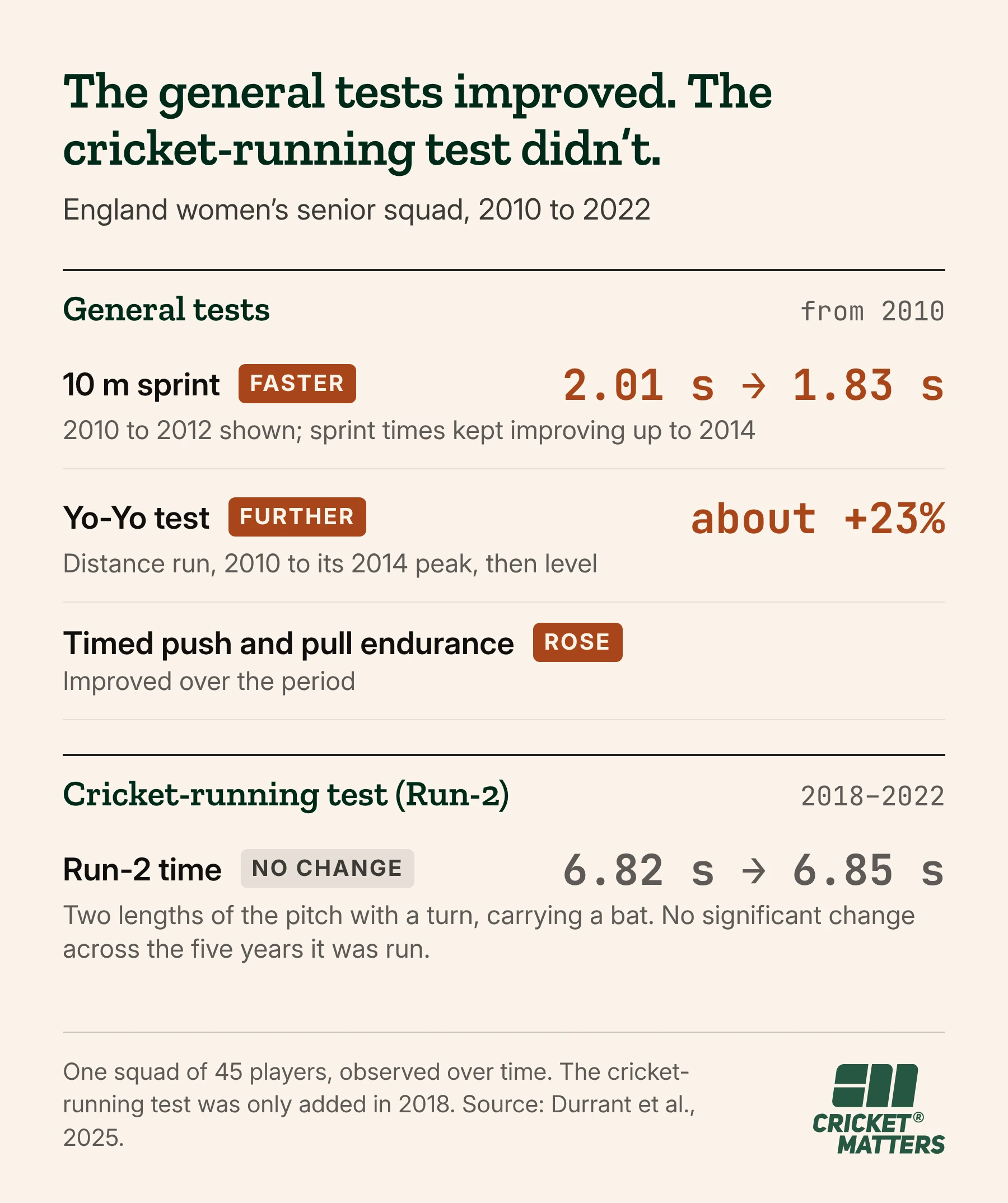
Those numbers cover different years. By 2018 the squad had already made big gains on the general tests, and the sprint and Yo-Yo results had levelled off. It’s one squad of 45 players. The researchers recorded what happened; they didn’t run an experiment, so it can’t say why.
The researchers’ own conclusion was that the squad’s next gains should come from speed and change-of-direction work. Our view sits beside theirs. A test score tells you a quality is there. It doesn’t tell you whether it’s showing up in your cricket, and that’s what an assessment looks at.
General tests still say something about the game. In 15 professional fast bowlers, those who jumped higher, sprinted faster over 20 m and scored better on the Yo-Yo tended to run more in 50-over matches. It’s a small study, and it shows the two go together, not that one causes the other.
How the qualities fit together is on our components of fitness for cricket page.
Why the 2 km keeps coming up
The 2 km time trial tests your aerobic engine: how long you can keep working hard. It needs a measured route and a stopwatch, which is part of its appeal.
It doesn’t tell you how fast you accelerate, turn, or repeat multiple short efforts, which is most of what running in cricket asks.
At the professional end, Lancashire’s squad averaged about 7:20 for the 2 km, and the quickest ran 6:40 (The Athletic, 2026). Those are first-class men’s times from one county, and they aren’t a general standard.
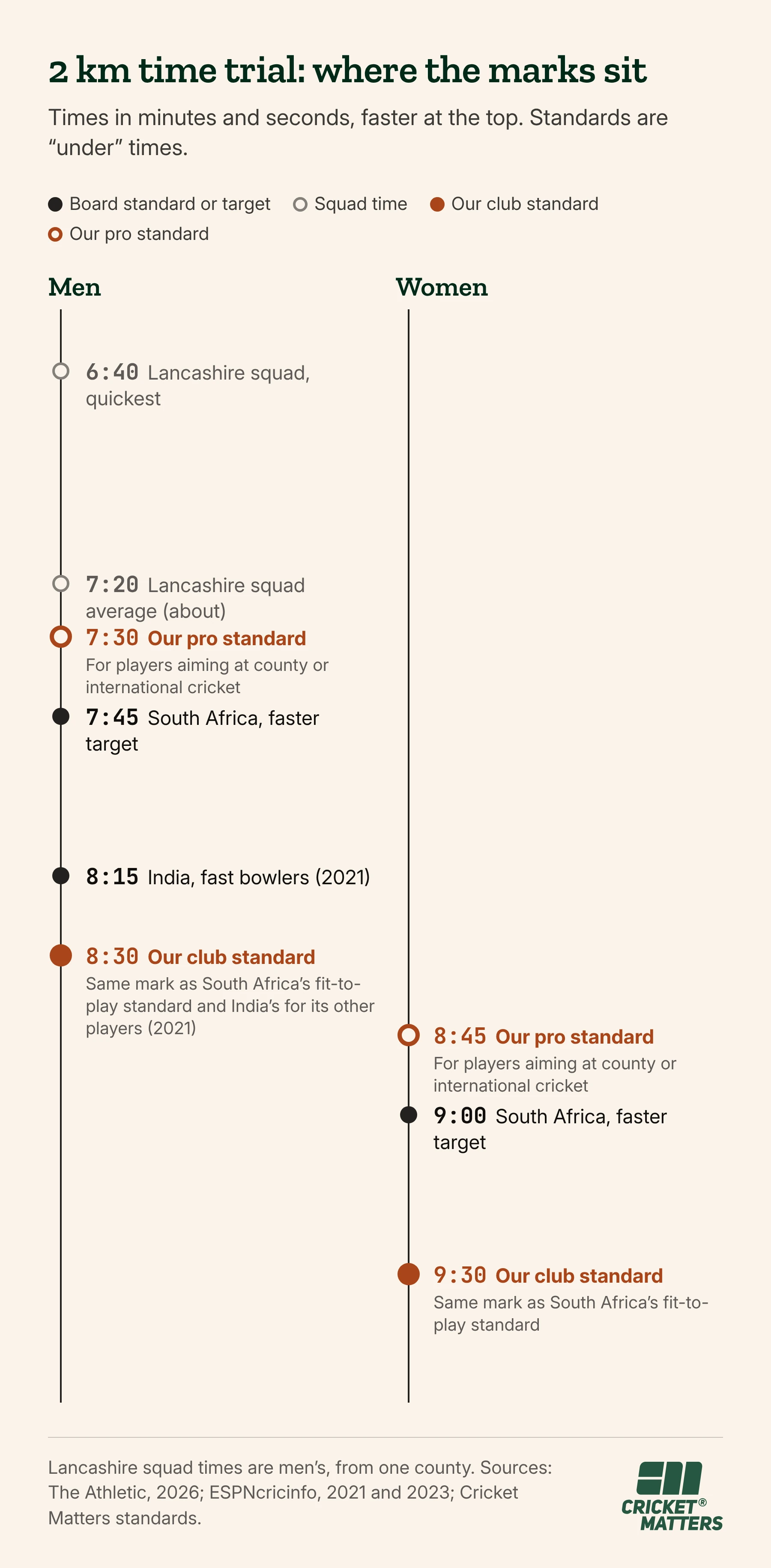
More on the 2 km test can be found on our 2 km time trial page.
How to test yourself: start with five tests
Five tests: one first thing in the morning, four in a single session. Here’s what you need, the order to run them in, and the number to aim for on each.
What you need
- A pull-up bar
- A stopwatch
- A tape measure
- A flat, non-slip bit of ground
- A smart watch, or a measured 2 km route
Before you start
Screen yourself before the 2 km or the jumps, to make sure you’re healthy enough to go flat out.
- If you have a heart, blood-pressure or joint condition, are pregnant, or are coming back from injury, speak to your GP first.
- If you’re over 50 and new to hard exercise, haven’t trained in the past 12 months, smoke, or have a family history of early heart disease, get the all-clear from your GP before the flat-out tests.
- Stop for pain. Chest pain, severe breathlessness or feeling faint: stop and call 999.
| Test | Label | Standard |
|---|---|---|
| 1. Resting heart rate | Readiness flag | Under 55 bpm · 55–69 · 70 and over |
| 2. The squat | Cricket Matters standard | Cleared · Not yet |
| 3. Extended arm hang | Cricket Matters standard | 60 seconds or more |
| 4. 2 km time trial | Professional benchmark | Under 8:30 men · under 9:30 women |
| 5. Broad jump | Cricket Matters standard | 120% of your height or more: Cleared · 110–119%: Monitor · under 110%: Action |
- Professional benchmark: a standard the professional game publishes or uses.
- Cricket Matters standard: one we use. Treat it as a guide.
- Readiness flag: about your health. Read it against your own normal.
Run them in this order
- Resting heart rate, when you wake.
- Squat test, before you warm up.
- Extended arm hang.
- Broad jump.
- 2 km time trial, last or on a different day. A hard run takes the spring out of your legs.
1. Resting heart rate
Count your pulse for a full minute when you wake, before you get up, or read it from a watch.
Read it against your own normal over several mornings. A reading that’s high for you, or creeping up, can mean you’re not recovering. A reading of 70 and over can mean you’re not fit enough yet, or not recovering well, though 70 and over is normal for many adults.
Watch for: some medicines, beta-blockers especially, change it. If it’s unusual for you on repeated calm readings, talk to your GP.
2. Squat test
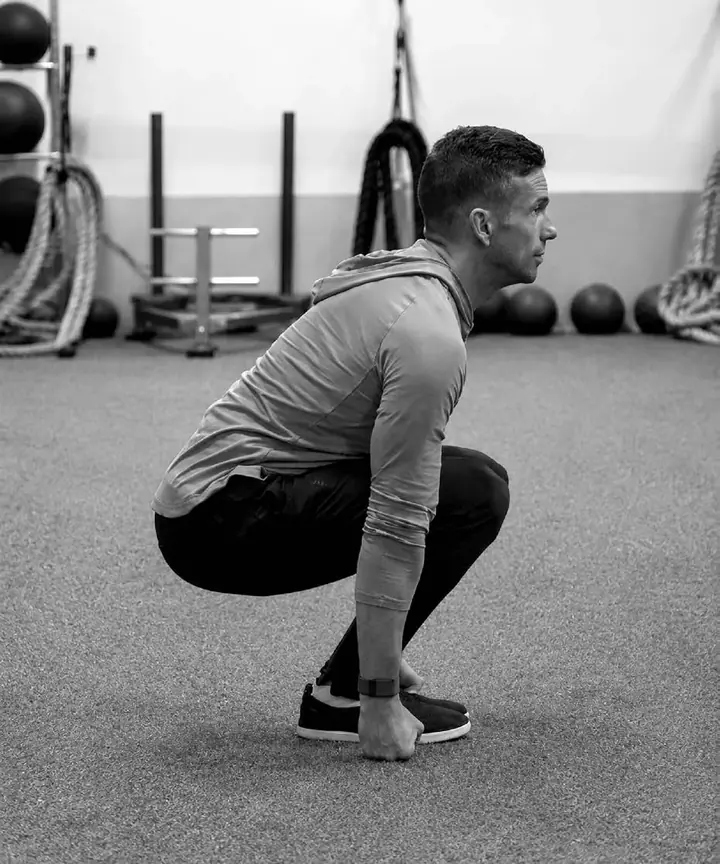
- Stand with your feet together, arms straight out in front of you, hands in fists.
- Squat down as far as you can go, heels flat on the floor and chest tall, reaching your fists towards the floor beside your feet.
- Stand back up.
Cleared if your fists reach the floor beside your feet, your thighs drop below parallel, and nothing hurts. It’s a yes-or-not-yet test.
If anything hurts, stop. Pain isn’t something to test around. Get it looked at by a clinician before you run any of the other tests. We do this in an injury assessment, in person in South Wales.
If you can’t reach the position but nothing hurts, that’s the most useful result here. Run the other tests anyway, so you have a starting point, and book your assessment if you want to find out why the squat isn’t clearing.
From our clinic
When a squat doesn’t clear, the cause is rarely strength. It’s usually stiff ankles, tight hips, or not yet knowing the difference between a squat and a hinge, where you bend from the hips. Once the squat clears, players tell us they feel freer, and we usually see their squat numbers climb. One semi-professional player’s back squat went from 140 kg, above parallel, to 180 kg at full depth, over four to six weeks of training once his squat cleared. That’s one player, not a promise.
Clearing the squat clears you to test, not to train harder or heavier.
3. Extended arm hang
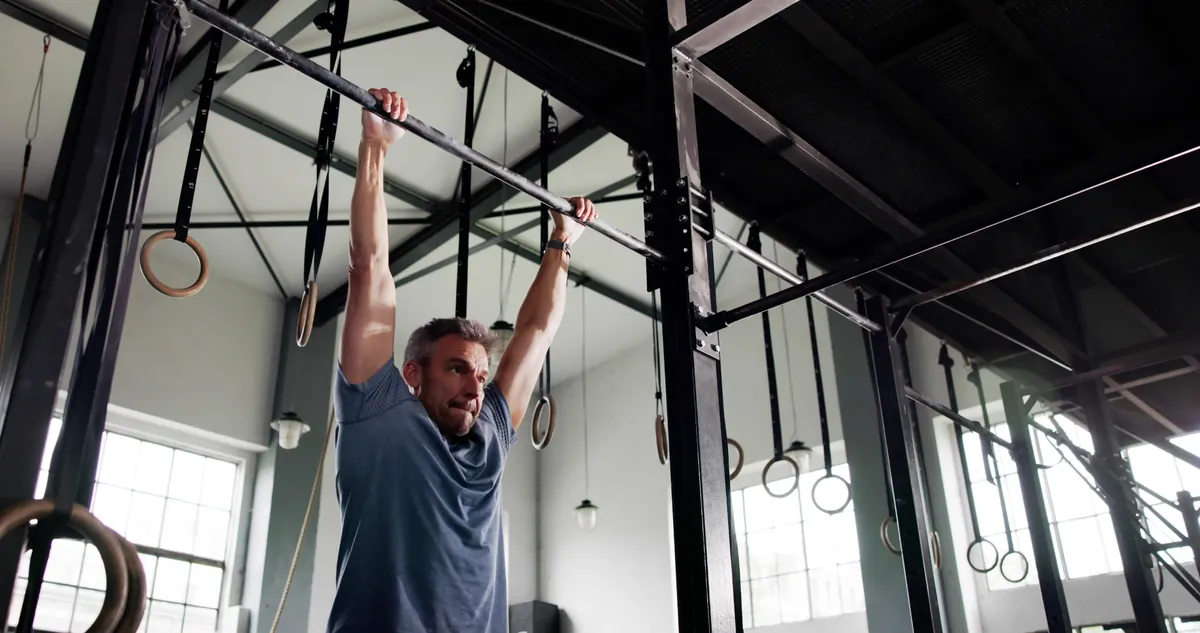
Hang from the bar at full stretch, arms straight, and hold.
Standard: 60 seconds.
Watch for: use a bar you can reach from the floor or a sturdy step, and step down rather than drop.
4. Broad jump
- Stand with both feet together at a start line.
- Swing your arms and jump forwards as far as you can, landing on two feet under control.
- Measure from the start line to the back of your heels. Take the best of three.
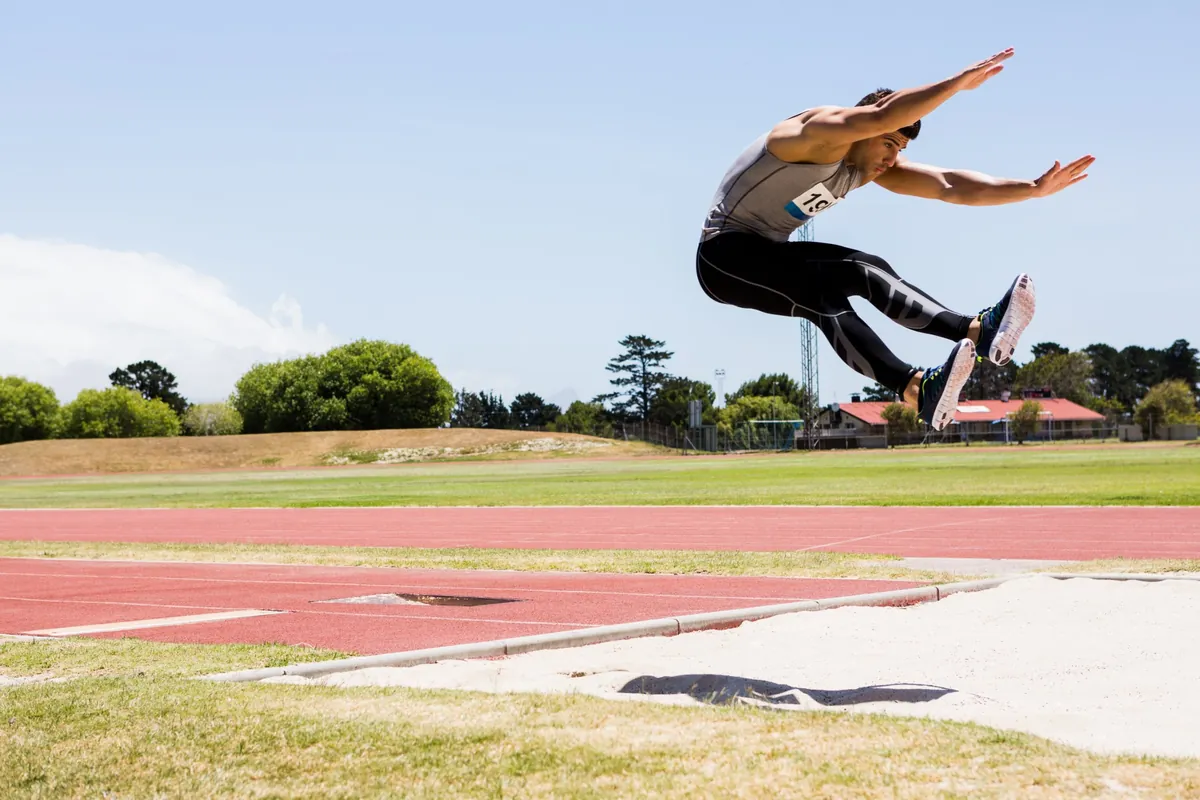
Standard: divide your jump by your height and multiply by 100. 120% or more is Cleared, 110–119% is Monitor, and under 110% is Action. It’s a strength and conditioning benchmark from outside cricket, which we set a step higher.
Watch for: jump on a flat, non-slip surface. If you can’t land balanced and under control, record what you got and leave the maximal attempts for now.
5. 2 km time trial
Run 2 km, timed and measured on a smart watch, or on a measured route with a stopwatch.
Standard: under 8:30 for men and under 9:30 for women. Those are South Africa’s 2 km standards (ESPNcricinfo, 2023), not applied rigidly since 2023, and India set the same 8:30 in 2021 for its men other than fast bowlers (ESPNcricinfo, 2021). If you’re working towards county or international cricket, our pro standard is under 7:30 for men and under 8:45 for women.
Watch for: if you haven’t been running, don’t start with a flat-out 2 km. Build up to it first, starting with a 20-minute brisk walk; our 2 km page shows how to train for it.
Write every number down. Re-test at the same time of day, on the same surface, the same way. The re-test is what counts.
These standards are for adults; juniors are covered further down.
These five are a snapshot. The full set, with the standard for each test, is in the free testing book.
Understanding your results
One number on its own tells you little. The pattern across the five tells you where to start. Three rules come first.
- Pain comes first. If anything hurt during any test, stop and get it looked at.
- The squat comes before running. While it hasn’t cleared, hold off most running and do your fitness work on other kit, such as a bike or rower.
- Read the pattern across all five, not one number.
What a short result points to
- Resting heart rate high, or creeping up: look at recovery first (sleep, how much you’re training, and what else life is throwing at you) before you add more training.
- Squat Not yet, with no pain: the movement is your first job. The usual reasons are the ones under the squat test above. Don’t add weight to the squat yet: work on reaching the position first.
- Arm hang short of 60 seconds: grip and shoulder endurance, the strength that holds you together through a long day in the field. Start with shorter hangs you can finish with your shoulders set, and build up over time. If a hang hurts your shoulder, stop.
- 2 km over the standard: the engine isn’t built yet, and running more time trials won’t build it. Once your squat has cleared, start at a level you can manage, a 20-minute brisk walk or an easy 5 km run, mostly at a pace you could hold a conversation at, adding time before speed.
- Broad jump short: there’s power still to find. If your arm hang or 2 km is short too, those come first: jump numbers tend to rise once the strength and engine underneath catch up. Easy jumping and landing practice is fine from the start. Under 110% of your height, leave bounding (big, springy strides) and repeated jumps until the broad jump comes up.
- Everything Cleared: keep re-testing and track the trend. For strength, start with our strength training guide, and train it with the gym workout for cricketers.
A worked example
This player is made up. We’ve combined results we often see in club cricketers in our clinic into one example. An adult male seam bowler: resting heart rate 63, squat Not yet with no pain (heels lift before depth), extended arm hang 35 seconds, 2 km in 9:15, broad jump 112% of height (Monitor). Nothing hurt, so all five tests run.
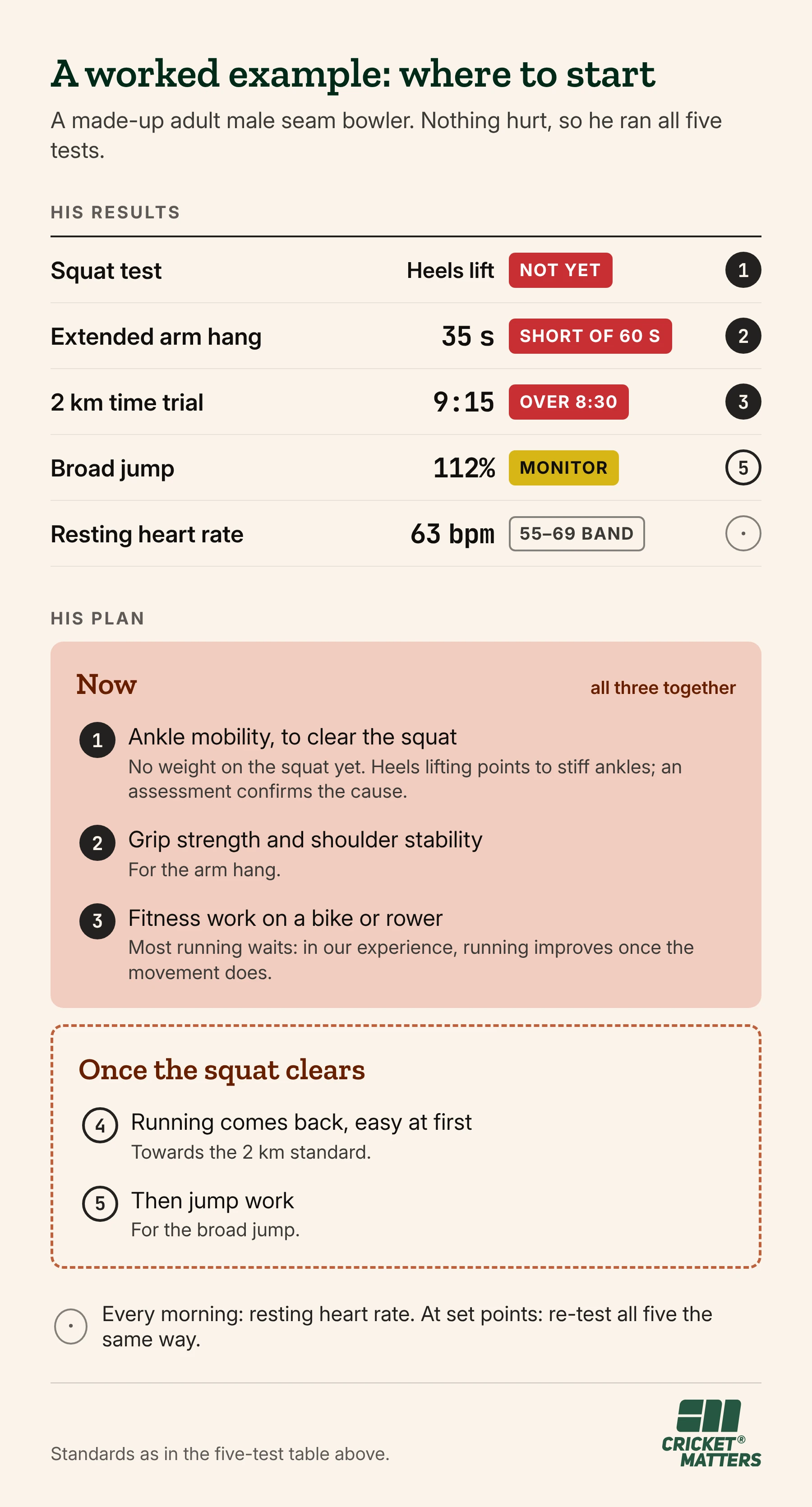
The squat comes first. His heels lift, which points to stiff ankles, so the first job is ankle mobility, with no weight on the squat yet. A home test can’t confirm the cause; an assessment can.
Alongside it, his arm hang is furthest from its standard, so grip strength and shoulder stability work starts now too.
Most running waits until the squat clears. In our experience, running improves once the movement does, so for now his fitness work goes on other kit, an assault bike or rower for example. When the squat clears, running comes back, easy at first. The broad jump waits for the squat, the arm hang and the 2 km. Keep taking the resting heart rate; it tends to come down as fitness builds. Re-test all five the same way, and read the results again.
The standards we use for club cricketers
There are no published fitness standards for adult club cricketers. Researchers have described groups of players; nobody has set standards for the club game.
So the Cricket Matters standards on this page are ours. They were worked out together by the Cricket Matters team, from years of testing cricketers and other athletes, our own testing records, working alongside other experienced coaches, and data from other sports.
Where a test has three possible results, Cleared means at or above the mark: keep going, and re-test to track. Monitor means close but not there, worth attention and worth a re-test soon. Action means the number is telling you to do something about it.
A standard describes a reading. It can’t tell you you’re injured, or that you aren’t, and it doesn’t predict how you’ll play.
These are standards for club cricketers. If you’re on a professional contract, your board’s numbers come first. Our pro standard on the 2 km, under 7:30 for men and under 8:45 for women, is for players working towards that level. On a board’s testing day, what follows a missed mark is the board’s call: since 2023, South Africa has not applied its 2 km standard rigidly as a selection rule, and its head coaches decide.
Tests you don’t need to run at home
The Yo-Yo test needs a marked 20 m course, a recovery zone and the audio track, and it’s hard to run accurately on your own. The 2 km covers your engine at home. The Bronco (repeated shuttle runs of 20, 40 and 60 m) is another running test of the engine, and the 2 km covers that too.
Short sprints are hard to time accurately by hand, and sprinting flat out before your movement has been screened isn’t the place to start. The cricket-running test needs timing gates to read accurately.
Lab jump tests use force plates, a platform that measures how hard you push into the ground. At home, the broad jump is your test of leg power. Skinfold (body-fat) measures only mean something in trained hands, and scales and a tape measure are the home substitute.
In our assessment, everything starts without equipment. Nothing is tested with kit until a player has cleared our movement and strength screens.
For parents of junior cricketers
The tests on this page are for adults. A child is still growing, and a fitness number at 12 says as much about growth as it does about fitness. In one study of youth cricketers, players further through their growth did better on the jump and power tests.
So we test juniors differently. Our junior screen, for ages 6 to 16, looks at the movement skills cricket is built on: running, jumping, hopping, skipping, catching, throwing and striking a ball. We check each one against what’s expected for the child’s age and track growth from one screen to the next. We’ll publish more on it soon.
If your child wants to try something from this page, make it the squat test, with you or a coach there, stopping if anything hurts. Compare each result with their own last one, never a teammate’s.
Some counties do run fitness tests with age-group players. Nottinghamshire’s Athletic Development Information 2025, for example, lists a 2 km time trial, a jump, a 20 m sprint, a cricket-running test and a side plank for under-13s to under-18s. If your child has a testing day coming up, it’s fair to ask what’s being tested, why, who sees the results and what happens next. More for parents is in our junior cricket articles.
Getting the full picture
If you’re testing yourself, start with the book. It has the full home battery, the standards we use and what to do with your numbers, plus what the professional game tests and why. Get the free testing book
What a home test can’t tell you is whether your qualities show up when you bat, bowl and field. That’s what the assessment is for, in person in South Wales or online.
Cricket fitness test FAQs
What is the fitness test in cricket?
There isn’t one. Each board, county and state runs its own set of tests, and they change over time; the 2 km time trial is the one that keeps turning up. A test score tells you a quality is there; whether it’s showing up in your cricket is a separate question.
What is a good 2 km time for a cricketer?
For club cricketers we use the professional benchmark: under 8:30 for men and under 9:30 for women. Those are South Africa’s standards (ESPNcricinfo, 2023), not applied rigidly since 2023, and India set 8:30 in 2021 for its men other than fast bowlers (ESPNcricinfo, 2021). If you’re working towards county or international cricket, our pro standard is under 7:30 for men and under 8:45 for women.
Do club cricketers get fitness tested?
There are no published fitness standards for adult club cricketers. You can still test the same qualities yourself with a tape measure, a stopwatch and a bar.
What is the Yo-Yo test in cricket?
A running test: you run 20 m and back to beeps that get faster, with 10 seconds’ walking recovery between each. Lancashire have dropped it (The Athletic, 2026); Middlesex still ran it in late 2025. It’s hard to run accurately on your own, and the 2 km covers your engine at home.
How often should I test my fitness?
At set points, for example before, during and after the season, the same way each time, so each result compares with the last.