
Strength & Conditioning for Cricket
The Engine for Power, Speed, Performance and Longevity.
Performance and durability are not crafted by accident. They are engineered. Strength & Conditioning at Cricket Matters exists to answer one fundamental question: Does your body have the capacity to execute your technique under match-day stress — repeatedly, safely, and without breaking down?
This is not gym training. It is performance infrastructure.
Why Most Cricket Strength & Conditioning Plans Fail.
Most cricket fitness programmes focus on getting stronger in ways the game doesn’t reward. They chase:
- Bigger lifts
- Faster bars
- Generic “power”
Cricket technique doesn’t fail because they aren’t strong enough. It fails them because their bodies cannot tolerate, absorb, and transfer force under fatigue.
When physical capacity is missing, technique collapses — not because intent is wrong, but because the body has no other option.
We don’t build physiques. We build engines designed for cricket.

Why Technique Breaks Under Pressure.
Many cricketers look technically sound in the nets — and break down during matches. This is not a technical failure. It is a capacity failure. This is explained by the Cricket Matters Athletic Pyramid.
The Cricket Matters Athletic Pyramid
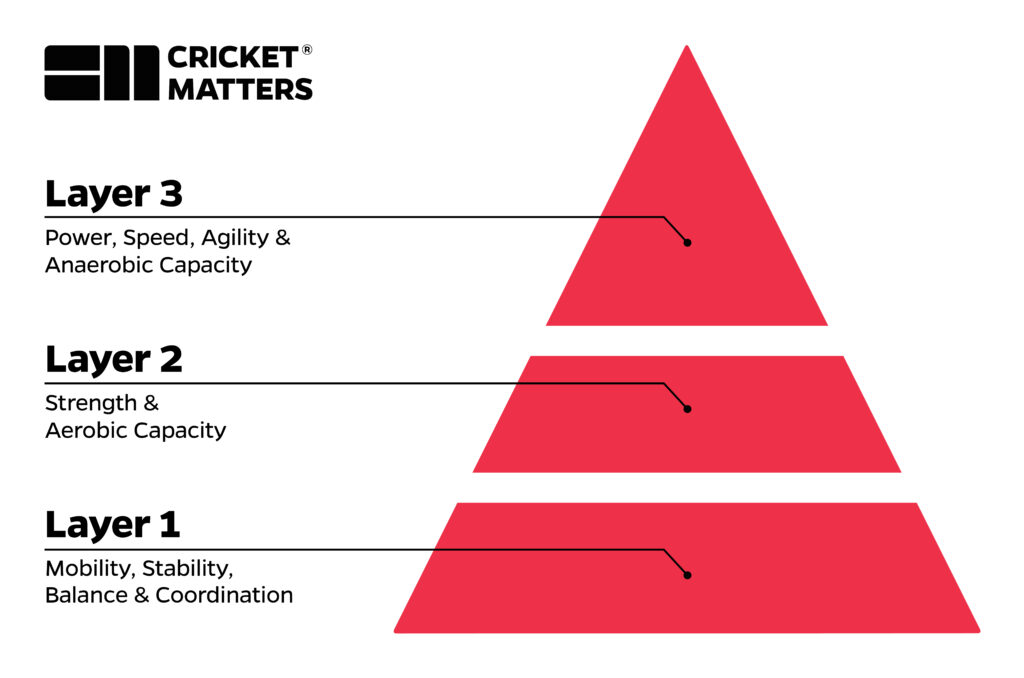
Layer 1: Movement Foundations.
Mobility, stability, balance, and coordination determine access to positions and basic control. Deficits here increase injury risk and compensation.
Layer 2: Strength & Aerobic Capacity
This layer supports force transfer and recovery between efforts. Without it, technical intent cannot be sustained.
Layer 3: Power, Speed & Anaerobic Capacity
This layer determines match-deciding actions — sprinting, bowling spells, explosive hitting — under pressure.
Mental Resilience (Integrated)
Mental resilience is not trained in isolation. It emerges when physical capacity supports decision-making under fatigue.
If lower layers are insufficient, upper-level technique collapses — regardless of coaching quality.
The Athletic Pyramid explains why technique fails under match pressure. The Performance Flywheel explains how technique is supported — or degraded — in real time.
The Performance Assessment uses both models together: one to identify structural weaknesses, the other to understand how those weaknesses affect technique ball after ball.
The Concept: Paying the Movement Tax
Cricket is rotational, asymmetric, and repetitive.
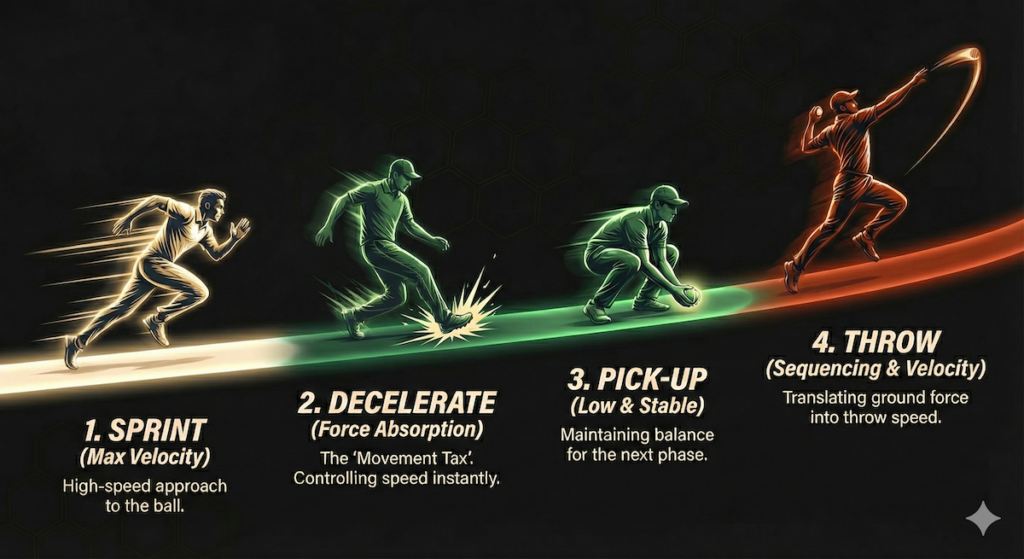
Every delivery bowled. Every explosive shot played. Every sprint made.
Each action carries a movement tax.
Capacity vs. Debt.
- If your physical capacity is sufficient, the tax is paid by muscle.
- If capacity is insufficient, the body borrows from joints, tendons, and ligaments.
That debt accumulates quietly — until it shows up as:
- Back pain
- Side strains
- Shoulder overload
- Loss of speed
- Loss of availability
Strength & Conditioning at Cricket Matters exists to expand capacity, so technique is never overruled by physical constraint.
What Strength & Conditioning Is Responsible For.
This service is not measured by how hard you train. It is measured by what holds up.
Strength & Conditioning at Cricket Matters is responsible for:
- Absorbing force safely
- Decelerating rotation under load
- Transferring power without leakage
- Repeating outputs under fatigue
- Protecting long-term availability
If performance fades late in spells, innings, or seasons — this is where the problem lives.

The Three Pillars of Performance and Durability.
We do not train aesthetics. We train for the biological demands of cricket.

1. Eccentric Braking Capacity
In cricket, the ability to stop is more important than the ability to go.
We engineer the eccentric strength required to:
- Absorb ground reaction forces
- Protect the knee during high-speed deceleration
- Control landing forces in bowling, batting, and fielding
This is how ACLs, hamstrings, and backs are protected — without reducing intent.
2. Rotational Stability
We do not train “core.” We engineer force transfer.
Our focus:
- Ground → hips → trunk → bat/ball
- Torque without spinal shear
- Rotation that doesn’t finish in the lumbar spine
Power emerges when force is transferred efficiently — not forced through weak links.
3. Tissue Tolerance
Muscle strength is not enough.
Cricket demands connective tissue that can tolerate:
- High torque
- Repeated loading
- Asymmetric stress
- Long seasons
We prepare tendons and ligaments for the realities of the game, ensuring structural permission to train and compete without restriction.
Built for How You Play Cricket.
Fast bowlers, batters, fielders, and wicketkeepers do not share the same physical problems — even if they share exercises.
Your programme is shaped by:
- Your role
- Your injury history
- Your workload
- Your constraints
- Your season phase
More work is not better. Better work, applied at the right time, is.
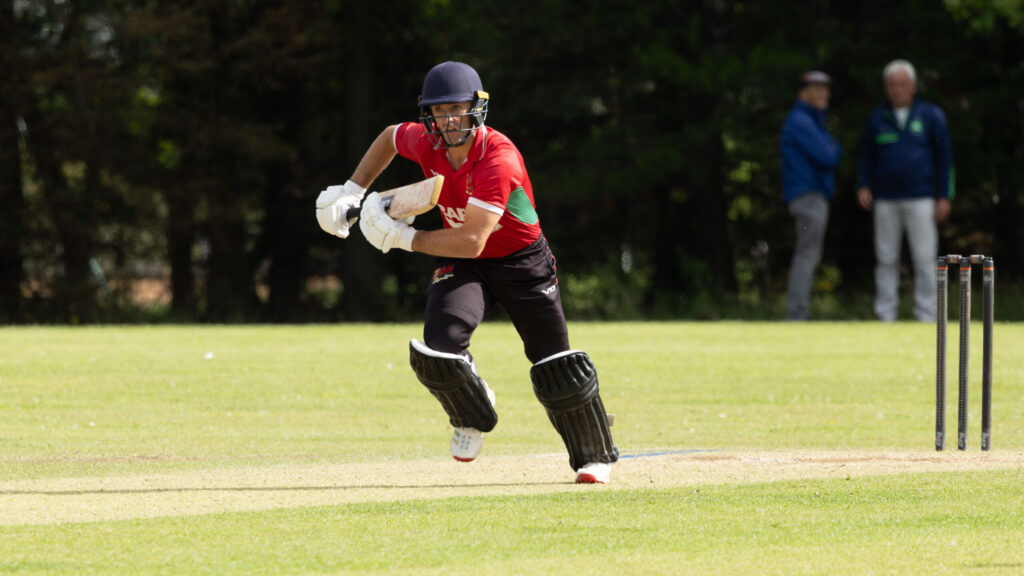
How Strength & Conditioning Fits Inside the System.
Strength & Conditioning at Cricket Matters is not isolated. Every athlete follows the same professional sequence:
Assessment → Roadmap → Capacity Built → Technique Applied
This ensures:
- Technique is supported by physical tolerance
- Injury risk is addressed before it escalates
- Performance survives fatigue, not just training sessions
Location doesn’t change standards. It changes where the work happens.
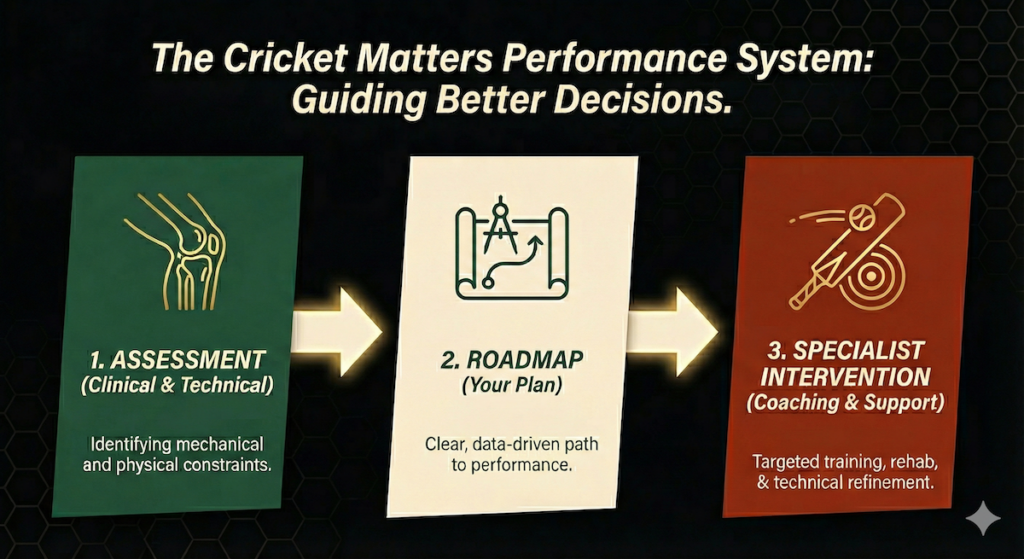
Why Assessment Comes First.
We do not write programmes for bodies we haven’t assessed.
Physical preparation without diagnostics is guesswork — and guesswork breaks athletes.
All Strength & Conditioning begins with:
- Structural screening
- Load tolerance assessment
- Constraint identification
- Clearance to progress
If pain is present, training waits. If capacity is missing, it is built — not ignored.
This is how long-term performance is protected.

What We Assess: The Performance Flywheel in Action.
At the centre of the Cricket Matters Performance System is technique — not as a starting point, but as an output. Our Performance Assessment uses a flywheel model to examine every factor that supports or degrades technique under match conditions.
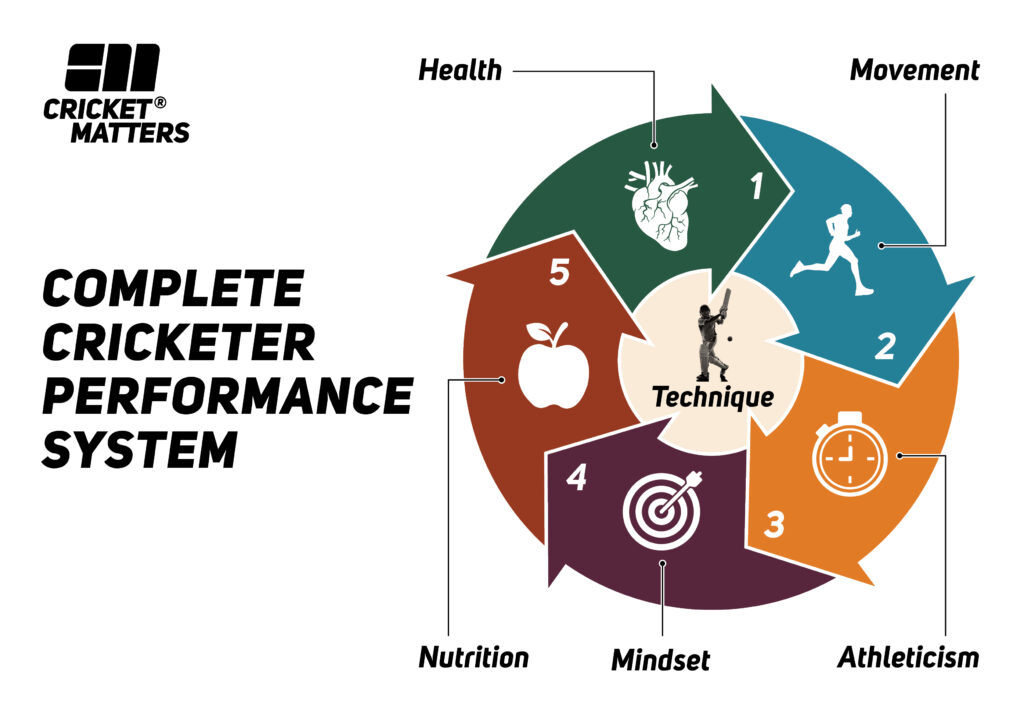
Clinical Health & Injury History.
Where appropriate, we assess:
- Pain, previous injuries, and recurring issues
- Recovery capacity and workload tolerance
- Risk factors that alter movement quality and decision-making
Unresolved clinical issues change how the body moves—and how technique presents under pressure.
Cricket-Specific Mechanics.
We analyse how your body expresses technique under cricket-specific demands, including:
- Fast bowling mechanics and overhead loading
- Foot strike and front-foot contact
- Rotational sequencing and torque for batters and bowlers
This identifies whether technical limitations are driven by physical constraints rather than coaching errors.
Physical Capacity & Load Tolerance.
We assess whether your body can support the technique you’re being asked to perform:
- Strength and force transfer
- Speed and power expression
- Fatigue resistance across spells, sessions, and matches
If capacity is insufficient, technique will collapse under load—no matter how good it looks in the nets.
Proof Without Noise.
Performance That Holds Up Under Pressure.
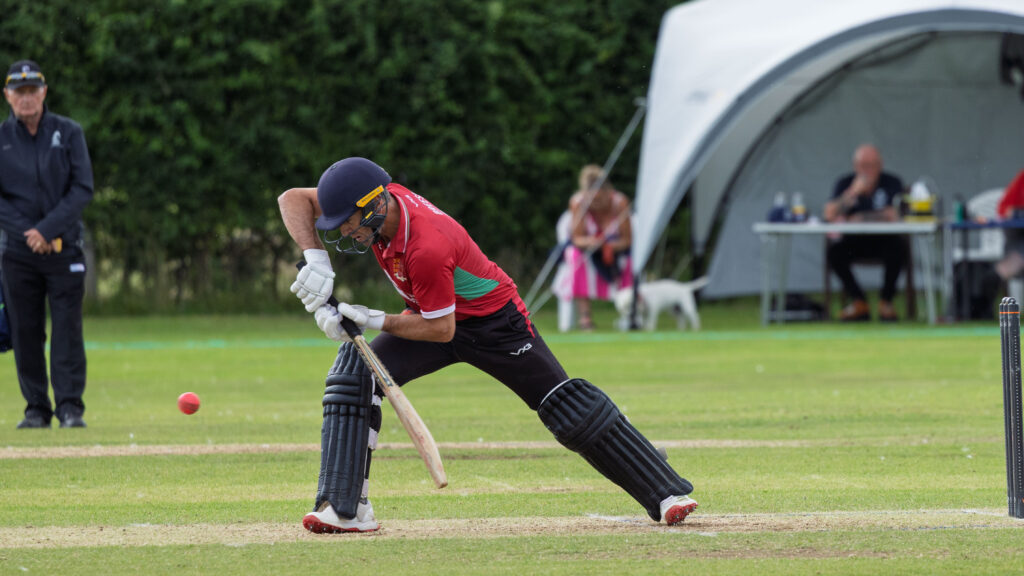
This performance engineering model is currently used to manage athletes across geographic boundaries, including international programmes where availability, fatigue management, and injury risk cannot be guessed.
It has survived real seasons, real workloads, and real fatigue — not controlled gym sessions. Not controlled gym sessions.
Who This Is For.
This service is for cricketers — and parents — who want performance that lasts.
- Players breaking down despite training hard
- Athletes returning from injury who don’t trust their body
- Cricketers whose performance fades under fatigue
- Parents seeking long-term development, not short-term gains
If effort is high but outcomes feel fragile, the issue isn’t commitment.
It’s capacity — and that can be engineered.

Who Leads the Strength and Conditioning Program.
The Cricket Matters Strength and Conditioning program is designed and overseen by James Breese, founder and Performance System Architect. James operates at the intersection of:
- Level 4 Sports & Remedial Therapy (LCSP Associate Member)
- ECB Cricket Coaching
- High-Performance Strength & Conditioning
This ensures that every training session—whether delivered in-person or via our remote platform—balances clinical safety, technical relevance, and performance intent.
Dealing With Pain or Injury?
If pain or injury is your primary concern, begin with a Cricket Injury Assessment instead. Clinical safety must be prioritised before performance decisions are made.

Choose Your Starting Point
Start in the Right Place.
Every cricketer starts with a free clarity call — to figure out together what makes sense next, before training, coaching, or assessment begins.
Twenty minutes. Free. No commitment.
Already a Client? Manage or Book Sessions Here