

James Breese | Performance System Architect
All clinical standards and performance engineering frameworks provided by Cricket Matters are overseen by James Breese, Level 4 Sports & Remedial Therapist (LCSP Assoc. Member) and ECB Coach. Our system integrates clinical biomechanics, metabolic nutrition, and neural efficiency to ensure athlete safety and elite performance output.
Common Cricket Injuries derail seasons when they’re ignored or mismanaged. Hamstring goes ping mid-sprint. Back locks up halfway through a spell. Shoulder feels like it belongs to someone else after a weekend in the field.
Every cricketer has been there — and most keep pushing until it’s too late.
The truth? Cricket punishes the same areas again and again. Ignore the warning signs and you’re not just sore — you’re sidelined. Lose form. Lose weeks. Sometimes even lose seasons.
The injuries every cricketer should know:
- Hamstring strains – the most common overall.
- Lumbar spine stress fractures – the most severe, especially in fast bowlers.
- Shoulder injuries – rotator cuff and cuff overload from bowling/throwing.
- Ankle and foot sprains – often underreported but frequent in bowlers and fielders.
- Groin and hip strains – particularly in batters sprinting quick singles.
- Hand, wrist, and finger injuries – from ball impact when fielding.
- Concussions – rising in junior and club cricket from ball strikes.
- Knee issues – sprains and tendon overload in all-rounders.
This guide cuts through the noise. The injuries you’ll actually face. The ones that cost players the most time. And, most importantly, when to push on vs. when to get checked.
Ignore the warning signs and you’re not just sore — you’re sidelined.
Table of Contents
The Quick Answer (Play On or Sit Out?)

Here’s the rule of thumb every cricketer needs:
- Sudden pain or loss of movement? Physio first.
- Sore, tight, heavy after matches? Recovery session (massage, mobility, light work).
- Niggle that fades then comes back? Both — assess the cause, recover the tissue, stop the cycle.
Fast Decision Table
| What you feel | First step | Why it’s the right move |
| Sharp pain, swelling, or can’t sprint/bowl/rotate | Physio assessment | Rule out real injury and get a plan |
| Heavy legs or stiff hips/shoulders after matches/travel | Recovery session | Ease soreness, restore range, feel fresher |
| Pain fades then returns when load goes up | Both (assess + recover) | Fix the cause and stop it repeating |
Sudden pain or loss of movement? Physio first. Soreness after matches? Massage. Niggle that keeps coming back? Both.
Why Cricket Bodies Break (and Where)

Cricket looks simple. It isn’t. It’s brutal in repetition.
- Fast bowling hammers the lower back with the same force, ball after ball.
- Fielding is max sprints, dives, and sudden stops — hamstrings and ankles pay the price.
- Batting demands smooth hip rotation and strong groin/adductors for quick singles.
- Throwing and bowling grind down the shoulder cuff and shoulder blades across a season.
Bottom line: Hamstring strains top the list. Lumbar stress injuries in fast bowlers are the most severe. If you don’t build strength, manage load, and keep recovery sharp, the fixture list will beat you before the opposition does.
Cricket breaks the same places again and again. The smart players don’t guess — they plan.
Have You Downloaded Our FREE 7-Day Gym Workout Plan?
Grab your complete step-by-step 7-day gym workout plan for cricketers today. There will be no more Guesswork. Just follow the plan and get results.
Injury by Injury — What to Do, What to Avoid
Cricket breaks the same places again and again. Backs in bowlers. Groins in batters. Hamstrings and ankles in fielders. The patterns don’t change — only how soon you deal with them.
This isn’t a textbook. It’s a field guide: how each injury happens, what it feels like, when to worry, and the first steps that actually help. Plus the roadmap back — rehab basics, return-to-play checks, and how to stop it coming back.
If something flares mid-season, use this as your map: push on, sit out, or get checked.
Hamstring Strains (Fielders, All-Rounders, Everyone)
Hamstrings are the No. 1 injury in cricket. One all-out sprint in the field, a sudden deceleration, or even a slip on wet ground — and it pings. That’s why they’re the single biggest cause of lost matches across all levels.
How it happens
Usually during max-effort sprinting, quick changes of direction, or sudden overstretching. Bowlers, all-rounders, and outfielders are especially vulnerable.
What it feels like
A sharp grab or pull at the back of the thigh. Speed drops instantly. Sometimes it’s just tightness; sometimes it stops you dead.
Red flags (see a physio, don’t guess):
- A loud pop
- Visible bruising within 24–48h
- Trouble weight-bearing or walking normally
First 72 hours (what helps, what doesn’t):
- Ease off load — don’t try to “run it off.”
- Compression and gentle mobility are fine.
- Keep moving within pain-free range — complete rest slows recovery.
Rehab roadmap
- Isometrics to calm pain and re-activate the muscle.
- Eccentric strength (RDLs, hamstring sliders) to rebuild tissue tolerance.
- High-speed running drills to restore sprint confidence.
- Change-of-direction work before full return to fielding.
Return-to-play checks
- Sprint at 90–95% with no pain or hesitation
- Strength equal to the other side (including Nordic tolerance)
- No apprehension with accelerations or sharp turns
Prevention
- Do at least one max-velocity sprint session a week
Lumbar Stress Injuries (Fast Bowlers)
The injury every fast bowler dreads. Repeated extension, rotation, and high workloads put enormous strain on the lower back. For younger bowlers especially, this can tip over into stress fractures — the most severe injury in cricket for time lost.
How it happens
Bowl after bowl, the lumbar spine takes the load. Add a sudden spike in overs or poor action mechanics, and the bone can’t keep up. Young, developing spines are especially vulnerable.
What it feels like
Deep, one-sided low-back pain that worsens with bowling, arching, or rotation. Unlike general stiffness, this pain doesn’t “warm up and go.”
Red flags (go straight for medical assessment):
- Pain at night or while resting
- Nerve symptoms (tingling, weakness, numbness)
- Pain that builds with bowling volume rather than easing off
First 72 hours
- Stop bowling immediately — no “just one more over.”
- Get assessed (often imaging needed to confirm or rule out fracture).
- Deload completely — protect, don’t provoke.
Rehab roadmap
- Core and hip strength to reduce spinal load.
- Thoracic mobility and rotation drills to spread the work away from the lower back.
- Bowling action review to spot technical red flags.
- Graded return plan: ball counts, intensity steps, and days between spells carefully managed.
Return-to-play checks
- Pain-free lumbar loading in gym and daily life
- Symmetry in single-leg squats and hop tests
- Can bowl through progression without pain bouncing back the next day
Prevention
- Monitor workloads: track overs, spikes, and rest days.
- Coaching on safe, repeatable action (mixed actions = higher risk).
- Build posterior-chain capacity (glutes, hamstrings, erectors) so the spine isn’t carrying the whole load.
Shoulder Overload (Bowlers & Outfielders)
The shoulder takes a hammering in cricket — hundreds of throws in the deep, overs of bowling, and little rest in between. It’s no surprise cuff and tendon irritation are among the most common problems players face.
How it happens
Repetitive overhead stress from bowling and throwing loads the rotator cuff and surrounding tendons. Spikes in volume (tournaments, extra net sessions, or too many long throws) are usually the trigger.
What it feels like
A dull ache or pinch at the front or side of the shoulder. You lose that “zip” on throws, or feel like your arm is lagging through the bowling action.
Red flags (get checked):
- True weakness with resisted movement
- Night pain that keeps you awake
- Pain that doesn’t ease with rest or mobility work
First 72 hours
- Cut back bowling/throwing volume, don’t push through.
- Pain-guided isometric holds (gentle cuff activation) to calm things down.
Rehab roadmap
- Scapular control: build up serratus anterior and lower trap strength to stabilise the shoulder blade.
- Cuff loading: progress from isometrics → light resistance → functional drills.
- Thoracic mobility: free up rotation so the shoulder doesn’t carry it all.
- Graded throwing/bowling program: step back up slowly with controlled distances and loads.
Return-to-play checks
- Full overhead range of motion without pinch
- Pain-free resisted external rotation (key cuff test)
- Can tolerate progressive long throws or overs without flare-ups
Prevention
- Keep a regular shoulder strength routine (cuff, scap, upper back).
- Avoid sudden spikes in overs or throwing sessions — build up gradually.
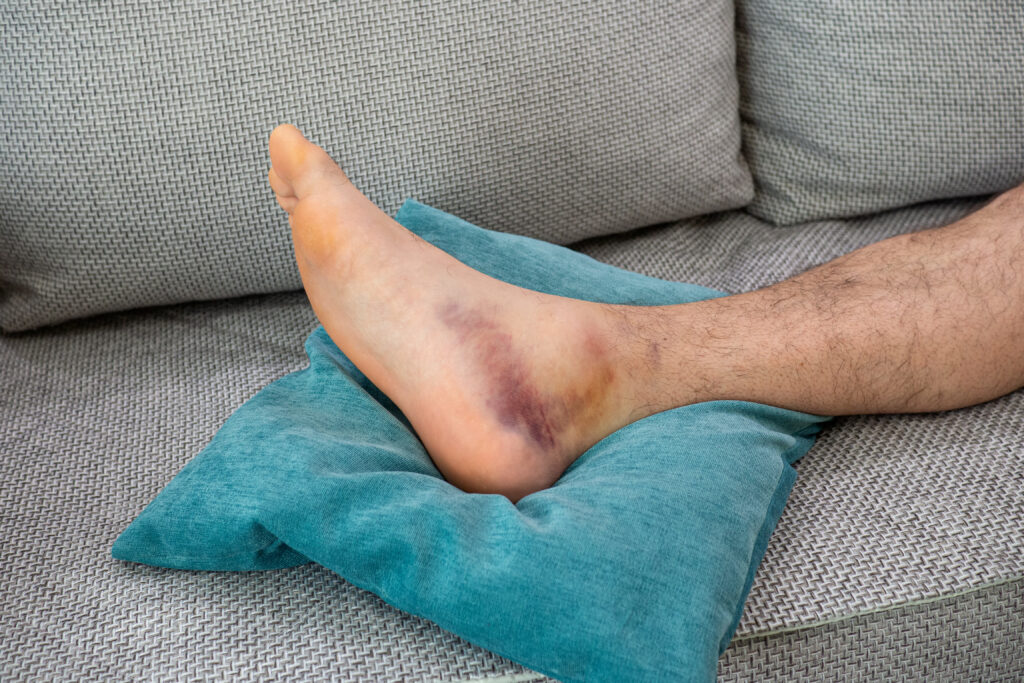
Ankle & Foot Sprains (All Roles)
Whether it’s a bowler landing in a dodgy foot hole, a fielder twisting in the outfield, or a batter turning sharply for a second run — ankle sprains are everywhere in cricket. They’re often brushed off as “just a roll,” but ignore them and instability lingers all season.
How it happens
Most sprains come from awkward landings, sudden changes of direction, or slipping on uneven surfaces. For bowlers, unstable foot holes are a big culprit.
What it feels like
Sharp pain and swelling on the outside (lateral) ankle, sometimes with a sense of the joint “giving way.” Midfoot injuries are less common but more serious if missed.
Red flags (get checked):
- Unable to take four steps without pain
- Tenderness around the midfoot or base of the 5th metatarsal
- Severe swelling or bruising spreading quickly
First 72 hours
- Compression and elevation to control swelling
- Gentle, pain-free range of motion (don’t lock it up completely)
- Avoid forcing weight-bearing if you can’t walk normally
Rehab roadmap
- Balance & proprioception: single-leg stance, wobble board, progressing to cricket-specific positions.
- Calf & soleus strength: heel raises, bent-knee variations to restore push-off power.
- Hopping & agility: straight hops → multidirectional → cricket fielding patterns (short sprints, turns, dives).
Return-to-play checks
- Can complete hop tests (single, triple, and side hops) pain-free and with good control
- Change of direction at full pace without instability
- Tolerates drills taped and untaped (if tape/brace used early in rehab)
Prevention
- Keep peroneals (outer ankle muscles) strong — they’re your natural ankle braces.
- Use taping or bracing in the early return-to-play phase to reduce re-injury risk.
- Maintain fielding and running drills that challenge direction change under control.
Groin & Hip Strains (Batters; Sprint Between Wickets)
Few things slow a batter down more than a sharp pull in the groin. Sprinting hard for a quick single, braking to turn, or sudden changes of direction all load the adductors heavily — and once irritated, they can nag for weeks.
How it happens
Explosive accel/decel when running between wickets, sudden lateral cuts, or poor sprint mechanics overload the adductors and hip flexors. Over time, repeated stress builds into chronic groin pain if not managed.
What it feels like
A sharp tug or ache in the inner thigh or groin area, often worse with sprinting, cutting, or quick rotation at the crease. Sometimes stiffness lingers after long innings.
Red flags (get checked):
- Severe pain with walking or coughing (possible hernia or more complex groin injury)
- Pain that doesn’t settle within a week of rest
- Loss of hip rotation or strength compared to the other side
First 72 hours
- Relative rest from sprinting and turning drills
- Gentle mobility for hips and low back (don’t force stretch into pain)
- Light isometric squeezes (adductor ball squeezes) to maintain some activation
Rehab roadmap
- Adductor strengthening: start with isometrics, progress to loaded Copenhagen planks and resisted adduction.
- Hip rotation work: mobility drills for internal/external rotation, plus controlled strengthening.
- Sprint mechanics: reintroduce accel/decel under load, then progress to sharp turns and running between wickets at match pace.
Return-to-play checks
- Can perform squeeze test pain-free with near-symmetrical strength
- Full-speed change of direction without hesitation or pain
- Sprint between wickets repeatedly without restriction
Prevention
- Keep adductors strong year-round, not just in rehab.
- Build hip rotation mobility and control into regular training.
- Manage running load during congested fixtures — don’t ramp up sprint volumes overnight.
Wrist, Hand & Finger Trauma (Fielders & Keepers)
No part of the body takes as much direct punishment in cricket as the hands. Whether it’s a stinger at short leg, a mistimed dive in the outfield, or a gloved ball bending a keeper’s finger back, wrist and finger injuries are some of the most common — and the most disruptive.
How it happens
Ball strikes at close range, awkward landings when fielding, or repetitive impact for wicketkeepers. Even a minor sprain can sideline a player, and fractures are all too common when reaction catches go wrong.
What it feels like
Sharp pain on impact, swelling, and reduced grip strength. Fingers may feel unstable or “give way” when trying to catch or grip the bat.
Red flags (get checked):
- Visible deformity or malalignment (possible fracture/dislocation)
- Numbness or tingling (nerve involvement)
- Severe swelling or inability to grip at all
First 72 hours
- Protect the area with buddy strapping or splinting (if advised)
- Ice and compression to manage swelling
- Avoid heavy gripping or impact until cleared
Rehab roadmap
- Early protection: maintain mobility in non-injured fingers to avoid stiffness
- Tendon glides: gentle finger mobility drills to restore smooth motion
- Grip progressions: start with putty or soft ball squeezes, building to bat grip drills
- Graded catching: begin with soft ball work before progressing to higher-speed cricket balls
Return-to-play checks
- Full pain-free grip strength (comparable to uninjured side)
- Can catch repeatedly without hesitation or pain
- Wrist and finger range of motion restored for batting and keeping demands
Prevention
- Good catching technique (soft hands, absorb the ball)
- Keeper-specific finger strength and mobility training
- Taping or finger supports for players with previous injuries in vulnerable positions
Knee Pain (Fast Bowlers, Spinners, All-Rounders)
Knees take a hammering in cricket. Bowlers pound the crease, spinners load one side over and over, and all-rounders live in a cycle of squatting, diving, and sprinting. Over time, that stress shows up as pain at the front of the knee — often patellar tendon or cartilage irritation — that can drag on all season if not managed.
How it happens
- Repeated jumping and landing at the crease (fast bowlers).
- Rotational torque and low stance loading (spinners).
- High volumes of squatting, sprinting, or sudden stops (all-rounders).
- Poor landing mechanics or rapid load spikes add risk.
What it feels like
- Ache or sharp pain around the front of the knee (below or around kneecap).
- Worse with squatting, stairs, running in spikes, or landing heavily.
- Stiffness after matches, especially with congested schedules.
Red flags (get checked):
- Sudden giving way or “pop” during play.
- Persistent swelling or locking.
- Pain that doesn’t ease with rest.
First 72 hours
- Reduce painful loading (avoid repeated squats, sprints, or bowling spikes).
- Gentle range-of-motion work to stop stiffness.
- Isometric quad holds (wall sit or Spanish squat) to manage pain.
Rehab roadmap
- Isometrics for pain relief → heavy slow resistance (squats, step-ups, split squats) → plyometric progressions (hops, jumps, bounds).
- Hip and glute strength to support landing mechanics.
- Technique review: crease landing for bowlers, foot placement for spinners.
Return-to-play checks
- Pain-free squat and step-downs.
- Hop and landing symmetry side to side.
- Tolerates repeated landings and bowling without flare-up.
Prevention
- Keep quad and glute strength high year-round.
- Monitor landing loads (bowling counts, jump numbers).
- Prioritise recovery — sore knees after every match isn’t normal.
Concussion & Head Impacts (All Levels)
A short ball that sneaks under the helmet. A misfield at close range. A junior caught off guard by a top edge. Head impacts happen at every level of cricket — and unlike muscle strains, they’re not negotiable. Get it wrong, and the consequences go far beyond missing a match.
How it happens
- Direct ball strikes to the helmet, face, or head.
- Fielding close-in (slips, short leg) with limited reaction time.
- Accidental collisions — diving fielders, wicketkeeper–fielder clashes.
What it feels like
- Immediate headache, dizziness, confusion, or blurred vision.
- Delayed symptoms: nausea, fatigue, trouble concentrating, sensitivity to light/sound.
- In juniors, subtle signs like irritability or appearing “off” after a knock.
Red flags (urgent medical care):
- Loss of consciousness, repeated vomiting, worsening headache.
- Seizures, unsteady walking, slurred speech.
- Any suspicion of skull fracture or neck injury.
First 72 hours
- Remove from play immediately — “if in doubt, sit them out.”
- Medical assessment before return to any activity.
- Relative rest (light movement, no screens/stimulation overload).
Rehab roadmap
- Graded return-to-play protocol: symptom-free at rest → light aerobic activity → sport-specific drills → non-contact training → full contact/competition.
- Each stage typically lasts 24 hours, but progression only if no symptoms return.
- Close monitoring from a medical professional throughout.
Return-to-play checks
- Symptom-free at rest and with exertion.
- Cleared by a qualified medical professional.
- Completed full graded return without setbacks.
Prevention
- Well-fitted helmets meeting current safety standards.
- Coaching on safe short-leg/catching positions.
- Strict adherence to protocols — no “playing through” head knocks.
Rehab That Works (Without Guesswork)

Most players either rest too long or push too soon. The ones who come back stronger follow a system.
- Assess before you treat: Don’t just chase the sore spot. A hamstring strain might start at the hip, a shoulder issue might come from poor thoracic rotation. That’s why we screen movement and capacity first, not guess.
- Graded loading beats rest: Muscles and tendons don’t heal with ice packs alone. They respond to progressive strength and controlled stress — isometrics early, eccentrics as you build, then return-to-skill drills.
- Workload management matters: Bowl counts, sprint exposure, and recovery windows are as important as the rehab itself. Ignore them, and the cycle repeats.
- Team approach works best: Physio provides the diagnosis and rehab plan. Sports massage supports recovery and mobility. Coaching tweaks fix the technical leaks. Put them together and the chances of recurrence drop fast.
That’s the principle we work to at Cricket Matters. Not magic fixes, not guesswork — systems that fit cricket’s unique demands.
What to Do in the First 72 Hours (By Type)

The first three days are where most cricketers go wrong. Too much sofa rest and you stiffen up. Push through pain and you turn a strain into a tear. Here’s the smarter approach:
- Acute muscle strain: Back off sprinting or bowling, use compression to manage swelling, and keep moving in pain-free ranges. Start gentle isometric holds early — it calms pain and keeps the muscle switched on.
- Joint sprain (ankle, knee, wrist): Support with compression or elevation, and protect weight-bearing if normal walking isn’t possible. As pain allows, reintroduce balance drills to stop the joint from losing control.
- Back pain in bowlers: Stop bowling straight away. Don’t force repeated extension. Get assessed, deload, and focus on gentle mobility until you know what’s driving the pain.
These aren’t replacements for medical advice — they’re the basic steps that stop a bad situation from getting worse. From there, it’s assessment, rehab, and return-to-play done properly.
Return-to-Play Checklist (Cricket-Specific)

Coming back too soon is how most cricketers get stuck in the injury–reinjury cycle. Before you jump straight back in, here’s what needs to be ticked off:
- Hamstring: Sprint at 90–95% speed pain-free, with equal strength side to side (including Nordic tolerance). No hesitation or fear at top pace.
- Lumbar (fast bowlers): Progress through a graded bowling plan without flare-ups. Posterior-chain strength restored. Action reviewed for red flags.
- Shoulder: Full overhead range of motion, pain-free resisted external rotation, and a completed throwing/bowling progression.
- Ankle: Hop and balance tests passed, fielding drills done at match speed, confident cutting and changing direction.
Keep it simple: log DOMS at 24–48h, session RPE, overs bowled, throws made, and pain scores. If they hold steady — not spiking up — you’re ready.
Prevention That Actually Moves the Needle

You can’t prevent every injury in cricket. But you can lower the odds with the right pillars in place:
- Strength: Posterior chain (glutes, hamstrings, erectors), adductors, calf/soleus, rotator cuff, scapular control.
- Mobility: Thoracic rotation for bowlers, hip rotation for batters, ankle dorsiflexion for fielders and runners.
- Workload rules: Avoid sudden spikes in overs, sprints, or gym load. Plan deloads, especially in juniors whose bodies are still adapting.
- Protective kit & coaching: Helmets and guards aren’t optional. Sound catching, throwing, and bowling mechanics reduce load before it becomes injury.
Massage and recovery tools are part of the picture — they help you bounce back — but they don’t replace strength or good technique.
Evidence Snapshot (Why This Plan Works)

The research matches what cricketers see on the ground:
- Hamstring strains are the most common injury across levels.
- Lumbar stress fractures in fast bowlers cause the most time lost — and often derail careers if mismanaged.
- Shoulder and hand injuries link directly to repetitive throwing and close-fielding impacts.
- Ankle sprains are common and meaningful time-loss injuries, even if often underreported.
Rehab that works follows consistent principles: assess first, load progressively, and return to play in steps (as NICE guidelines support). Sports massage and recovery work reduce DOMS and help mobility, but they complement rehab — they don’t replace it.
That’s why the smartest players don’t guess. They assess, plan, and combine the tools that keep them fresher and stronger across the season.
Final Word

You don’t win a season by ignoring pain or pushing through every niggle. You win it by staying on the park — fresh, mobile, and confident enough to perform when it matters.
That means knowing the injuries cricket dishes out, spotting the red flags early, and following a process that works: assess → load → return-to-skill → monitor.
Simple, repeatable, and far more effective than rest-and-hope or rushing back too soon.
The truth is, most cricketers don’t fall to freak accidents. They break down because of the same patterns — hamstrings under sprint stress, spines under bowling loads, shoulders under endless throws. The smart players don’t guess; they plan. They build strength, manage workloads, use recovery tools, and surround themselves with the right team.
Keep your recovery simple and consistent. Don’t save your discipline for rehab — save it for match day. Because the cricketer who manages their body best doesn’t just last the season. They perform better every ball.
And if you want support from a team that lives and breathes cricket, that’s exactly what we do at Cricket Matters.
Have You Downloaded Our FREE 7-Day Gym Workout Plan?
Grab your complete step-by-step 7-day gym workout plan for cricketers today. There will be no more Guesswork. Just follow the plan and get results.
The cricketer who manages their body best doesn’t just last the season — they perform better every ball.
FAQ
What Is the Most Common Injury in Cricket?
Hamstring strains are the most common injury in cricket, affecting players across all roles due to the frequent sprinting, sudden directional changes, and explosive movements required during play. These injuries are particularly prevalent among fielders and batters who engage in repeated short-distance running. Research has consistently shown hamstring strains to be the leading cause of time lost due to injury in both male and female cricketers at the elite level.
What Are the Most Common Injuries in Cricket Fast Bowlers?
Fast bowlers are most frequently affected by lumbar spine stress fractures, hamstring strains, and ankle injuries. Lumbar stress fractures are considered the most serious and are caused by the repetitive and high-force spinal extension and rotation during delivery. Hamstring strains are also common due to sprinting in the run-up, while ankle sprains occur from high ground reaction forces at front-foot landing. These injuries often result from workload spikes, poor technique, or inadequate recovery between matches.
Is Cricket Considered a High-Risk Sport for Injuries?
Cricket is classified as a moderate- to high-risk sport for injuries, especially in fast bowlers and all-rounders who experience greater physical loads. While it lacks the frequent high-impact collisions seen in contact sports, cricket still poses significant injury risks due to repetitive actions, overuse, and long playing durations. Injury incidence is higher in elite formats with congested schedules, and fast bowlers have the highest injury rates among all player roles.